
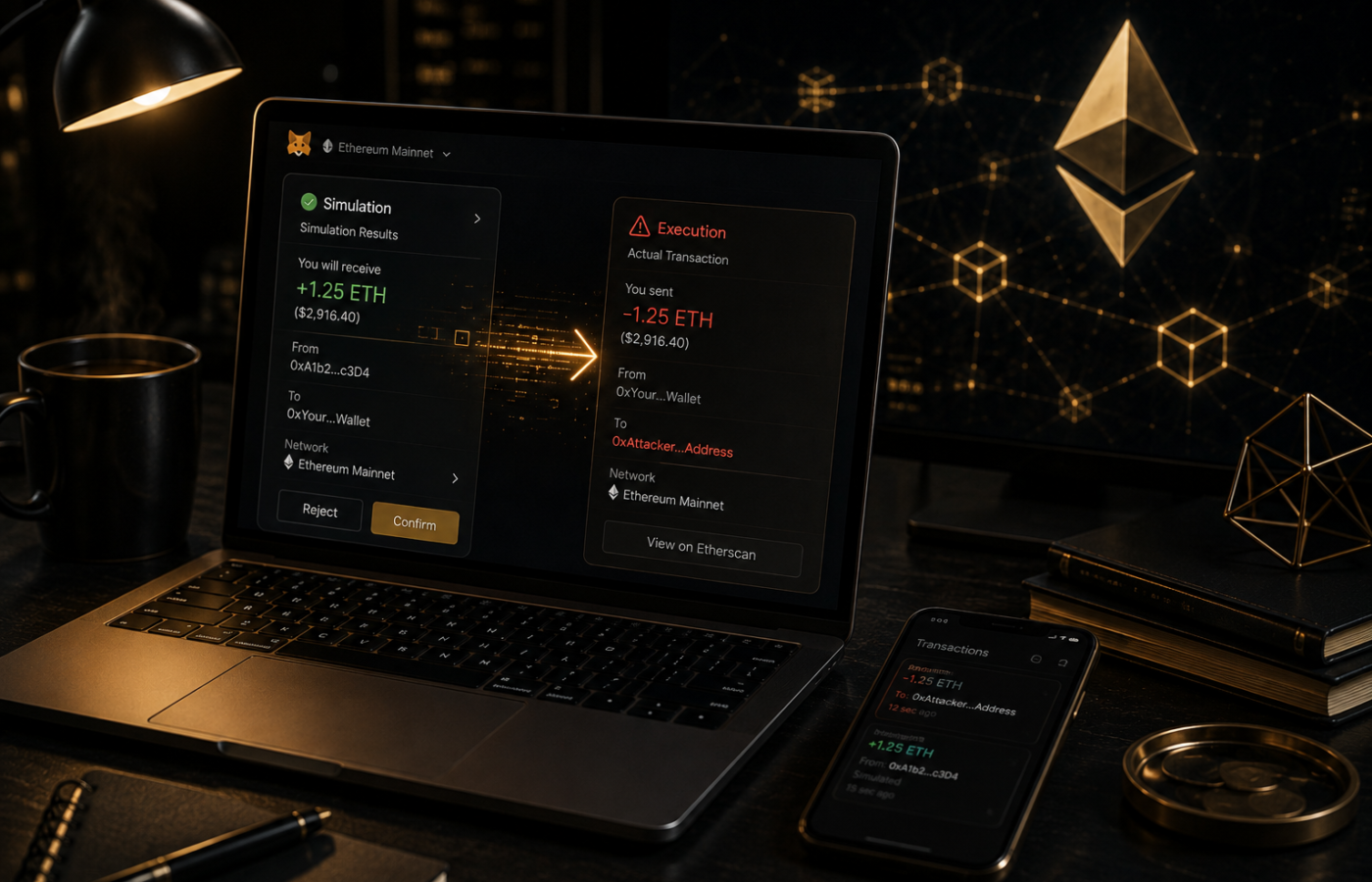
A new type of attack on Web3 wallets has been discovered. What is Transaction Simulation Phishing?

Most users believe that simulating a transaction in a Web3 wallet allows them to see its actual outcome in advance. However, a new study has shown that attackers have learned to bypass this security mechanism as well
Before signing a transaction, the wallet displays its expected outcome. The user can see which tokens will be sent, what they will receive in return, and how their balance will change. It is precisely thanks to this simulation that many fraudulent schemes have been detected even before the transaction was confirmed.
However, a new study has shown that cybercriminals have learned to circumvent this mechanism as well.
In late July 2026, a group of researchers published a paper titled “Transaction Simulation Phishing: The Hidden Threat to Ethereum Wallets,” which describes a new class of attacks targeting Web3 wallet users. The paper was posted to the arXiv preprint server on July 30, 2026. The authors did not merely describe a theoretical threat—they developed a system to detect such attacks and measured their scale in real-world networks.
Why Do Users Trust Transaction Simulations?
Modern wallets, such as MetaMask and other EVM-compatible solutions, simulate a transaction before sending it.
The transaction is not added to the blockchain. Instead, the wallet simulates its execution based on the current state of the network and shows the user the expected result.
For example:
- which tokens will be deducted;
- What assets will be delivered to the address;
- what permits will be issued;
- how the balance will change.
That is precisely why many people consider the simulation window to be the last line of defense before confirming an operation.
What is this new attack?
Researchers found that the simulation only shows results for the current state of the blockchain.
But there is a delay between the time a transaction is verified and the time it is actually included in a block—sometimes a few seconds, and sometimes tens of seconds.
During this time, an attacker could modify the smart contract's parameters.
As a result, the user sees a secure simulation, signs the transaction, but once it is included in a block, the contract executes a completely different branch of logic.
In other words, the simulation does not mislead the user. It honestly shows the result at the time of the check. However, the contract itself has time to change before the transaction is executed.
What does the diagram look like?
Let's imagine a website that offers free tokens.
The user connects their wallet and clicks the " Claim" button.
The wallet is running a simulation.
A safe result appears on the screen:
- the user receives tokens;
- There are no suspicious transfers.
A person confirms the transaction.
But during that time, the attacker alters the internal state of the smart contract.
Once the transaction is included in a block, a different set of rules takes effect, and the funds are transferred to the attacker's address.
It is this technique that researchers have dubbed " Transaction Simulation Phishing."
What methods do cybercriminals use?
The authors identified several mechanisms that allow the contract's behavior to be modified after simulation:
- a change in the internal state of a smart contract;
- the logic's dependence on another contract;
- behavioral changes depending on the volume of gas;
- dependence on gas prices;
- executing different scenarios depending on the block number;
- Executing different scenarios depending on the block time.
In all cases, the user sees a correct simulation, but the final result turns out to be different.
How serious is the problem?
To assess the scale of the problem, the researchers developed their own tool, SimGuard, and tested it on the four largest EVM networks:
- Ethereum;
- BNB Chain;
- Polygon;
- Avalanche.
The results were unexpected.
The following was discovered:
| Indicator | Meaning |
|---|---|
| Malicious Contracts | 4 224 |
| Affected users | More than 5,700 |
| Estimated damage | About $3.48 million |
| Loss Rate on the Ethereum Network | 91,5 % |
In addition, the study showed that about 83% of all identified proceeds went to just a few large groups of cybercriminals. This suggests that such attacks are already being carried out in an organized manner, rather than being isolated incidents.
Does that mean MetaMask isn't secure?
No.
It is important to understand that the investigation did not uncover any vulnerabilities in MetaMask.
The problem runs much deeper.
The very idea of simulation has a fundamental limitation: it provides a forecast based on the network's current state.
If the state of the smart contract changes before the transaction is executed, the prediction no longer reflects reality.
It is precisely this limitation that cybercriminals have learned to exploit.
Therefore, this new type of attack could potentially affect any wallets that use a similar simulation mechanism.
How to Protect Yourself
It is impossible to completely eliminate the risk of such attacks today, but it can be significantly reduced:
- Do not sign transactions immediately after connecting to unknown websites;
- avoid projects that require urgent confirmation of transactions;
- verify smart contract addresses using independent services;
- use a separate wallet to interact with new dApps;
- Regularly revoke issued token approvals.
Conclusion by KLYO
Over the past few years, Web3 wallet developers have gradually made user protection mechanisms more sophisticated. First came warnings about suspicious permissions, then the ability to decode smart contract actions, and later transaction simulation, which was designed to show the outcome of a transaction in advance.
A new study shows that attackers are adapting alongside these mechanisms. Now, rather than trying to circumvent the cryptography or the wallet itself, they are attempting to exploit users’ trust in the interface, which is considered the last line of defense.
This is an important signal for the entire industry. While the golden rule used to be “read carefully what you’re signing,” that may no longer be enough. Even an accurate simulation reflects only the state of the network at the time of verification and does not guarantee the final outcome after the transaction is executed.
So far, Transaction Simulation Phishing does not appear to be a widespread threat. However, the concept itself shows that as Web3 evolves, the battle will increasingly shift from breaking algorithms to finding ways to circumvent users’ familiar security mechanisms.
Source of the study
Transaction Simulation Phishing: The Hidden Threat to Ethereum Wallets (arXiv, July 30, 2026).
Thanks for the information—forewarned is forearmed!
A helpful article for both beginners and experienced users. The main rule: be careful and avoid connecting your wallets to random sites, or—as mentioned in the article—use an empty wallet.
For example, one of the wallets I use has a premium feature that shows whether there are any sanctions against a smart contract and whether the wallet is clean. But when it comes to security, your own knowledge is still the most important factor.
Thanks, that was an interesting read. I think the main thing is to use your head and not do anything crazy. And of course, having a few wallets and cards is a must.
Well, as they say, crime never sleeps.