
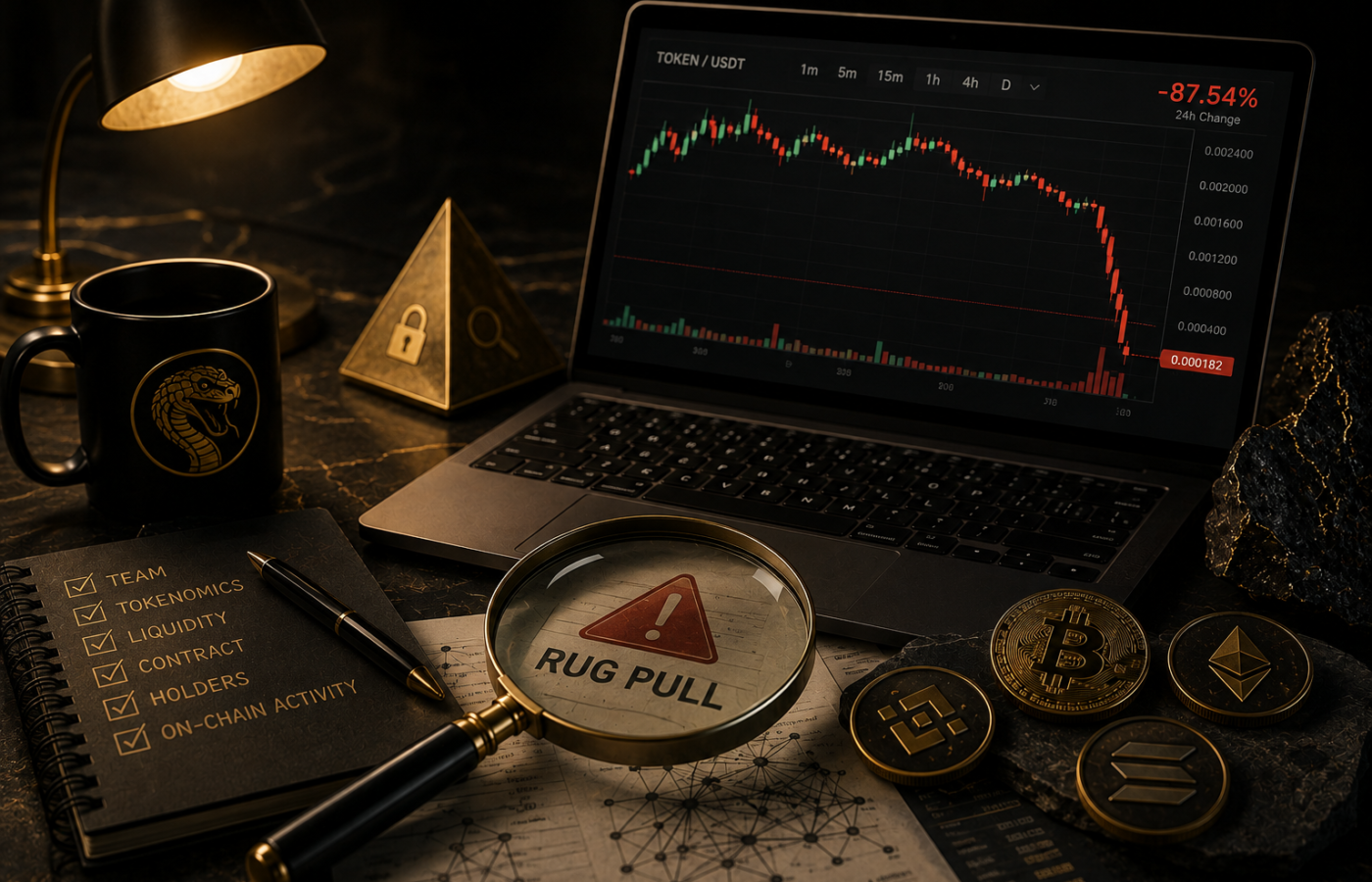
How to Spot a Rug Pull: A Complete Guide to Vetting Crypto Projects

Introduction
Every day, thousands of new tokens appear on various blockchains. Some become successful projects, others gradually lose the community’s interest, and some are created solely to defraud investors.
This scheme is known as a " rug pull."
Recent studies clearly illustrate the scale of the problem. The authors of the SolRugDetector study, which focuses on the Solana network, analyzed 100,063 new tokens and identified 76,469 projects showing signs of a rug pull. The minimum confirmed losses amounted to approximately $151 million.
These figures show that vetting a project before making a purchase is not an unnecessary precaution, but rather an essential step in any investment.
In recent years, this issue has attracted the attention not only of analytics firms but also of the scientific community. Studies by RPHunter, TM-RugPull , and SolRugDetector all reach the same conclusion: there is no single indicator that can identify a fraudulent project with 100% accuracy.
A secure smart contract does not necessarily mean an honest team. Locked-up liquidity does not guarantee that developers will not sell their tokens. Even a successful audit does not rule out fraud.
That is precisely why a comprehensive project analysis is considered the most effective approach today.
In this article, we'll go over how to research a crypto project on your own before buying and what tools to use for that.
What Is a Rug Pull?
A "rug pull " is a fraudulent scheme in which developers first generate interest in a new token, attract buyers and liquidity, and then find a way to withdraw funds or render the token virtually worthless.
The most common types of rug pulls:
- withdrawal of liquidity from the pool;
- issuance of additional tokens after launch;
- Honeypot contracts that prohibit sales;
- hidden administrative functions;
- a mass sale of tokens by developers;
- A gradual " Soft Rug Pull," in which a team sells its assets in small amounts over a long period of time.
In many cases, scammers use several methods at once.
Why Investors Become Victims
Most users make the same mistakes.
They buy the token because:
- the price is rising rapidly;
- The project is being actively promoted by bloggers;
- a large number of followers on Telegram or X;
- The website looks professional;
- The audit has been published;
- There is a lot of excitement surrounding the project.
However, none of these factors indicates that the project is safe.
Recent studies show that fraudulent projects often appear just as legitimate as genuine ones. Therefore, it is not the marketing that should be evaluated, but rather the objective data from the blockchain.
How to Evaluate a Crypto Project
1. Research the developers
The first question you should ask yourself is:
Who is behind this project?
Please check:
- Is the team known?;
- whether she had launched projects before;
- Are there any public developer profiles?;
- Is there a track record of successful projects?;
- Are the team's wallets linked to previous fraudulent schemes?
A study by RPHunter shows that analyzing developer behavior significantly increases the likelihood of identifying fraudulent projects even before liquidity is withdrawn.
2. Check the smart contract
Even if you don't know how to read code, most modern services automatically analyze potentially dangerous functions.
Please note the following:
- the possibility of an additional issuance (Mint);
- address blocking (blacklist) features;
- changes in fees;
- hidden administrative functions;
- Proxy contracts;
- options for transferring ownership rights.
If the contract is not verified, the risk increases significantly.
3. Check liquidity
A rise in price does not necessarily mean the project is safe.
It's important to understand:
- how much money is in the liquidity pool;
- who added it;
- Is it blocked?;
- when the lock expires;
- Can the developer withdraw liquidity?
Unlocked liquidity remains one of the most common signs of a classic rug pull.
4. Check the token distribution
The distribution of the proposal shows just how easily the project can be manipulated.
Please note:
- how many holders there are;
- What percentage is held by the largest addresses?;
- Is there a group of linked wallets?;
- Doesn't the team control most of the proposal?
A high concentration of tokens significantly increases the risk.
5. Review on-chain activity
The blockchain stores a history of all transactions.
Before making a purchase, it's a good idea to check out:
- who was the first buyer;
- who provided liquidity;
- Were there any transfers between linked wallets?;
- Did the developers sell any tokens?;
- Is the volume created artificially?
A study by SolRugDetector shows that analyzing the behavior of network participants is what makes it possible to identify many fraudulent projects much earlier than traditional verification methods.
6. Don't rely on just one metric
This is the main conclusion of current research.
A smart contract does not guarantee that developers will act honestly.
Locked-up liquidity does not rule out a massive sell-off by the team.
A large number of followers doesn't mean the project is legitimate.
The more independent factors you check before making a purchase, the higher the likelihood of detecting signs of risk in a timely manner.
Verification Tools
Differences in Verification Across Different Networks
Ethereum
Before making a purchase, we recommend checking the following:
- Has the contract been verified?;
- whether the owner has renounced their rights (Ownership Renounced);
- Are the Mint features available?;
- Is it possible to change the fees?;
- whether proxy contracts are used;
- Are there any hidden administrator privileges?
Ethereum has the most developed ecosystem of analytical services, so most of these checks can be completed in just a few minutes.
BNB Chain
BNB Chain remains one of the most popular networks for launching scam tokens due to its low fees and the ease of creating new projects.
Special attention should be paid to:
- the ability to freely sell the token;
- taxes on purchases and sales;
- the presence of a honeypot;
- contract review via GoPlus Security;
- the distribution of tokens among holders.
If several services simultaneously flag a risk, it's best to avoid making the purchase.
Solana
The approach to analyzing Solana differs from that of EVM networks.
Special attention should be paid to:
- Mint Authority — Can a developer issue additional tokens?;
- Freeze Authority — Can the owner freeze users' tokens?;
- to the owner of the liquidity pool;
- the first transactions after launch;
- token distribution;
- activity of the largest wallets.
Researchers consider these specific characteristics to be among the most informative when analyzing new projects.
What Recent Research Shows
Despite the use of different methodologies, the conclusions of most scientific studies are virtually identical.
A study by RPHunter shows that analyzing developer behavior and on-chain data is significantly more effective than simply auditing smart contracts.
The TM-RugPull project highlights the importance of analyzing a project over time. Many indicators only become apparent after observing how events unfold, rather than through a one-time check.
A study by SolRugDetector shows that liquidity activities, the holder structure, and the behavior of early market participants are key factors for the Solana network.
The overall conclusion of all the studies is the same:
The more independent factors are taken into account when analyzing a project, the higher the likelihood of identifying signs of a rug pull before purchasing the token.
Conclusion KLJO
There is no universal way to identify a rug pull.
However, recent studies show that fraudulent schemes rarely conceal absolutely all of their telltale signs. More often than not, they leave behind numerous small clues that become apparent upon close scrutiny.
Researching the developers, analyzing the smart contract, and checking liquidity, token distribution, and on-chain activity can significantly reduce the likelihood of falling victim to a scam.
These checks do not guarantee that the project will be successful, but they help identify the most serious risks before making a purchase.
It's much easier to spend 10 minutes analyzing a project than to try to figure out later where your money went.