
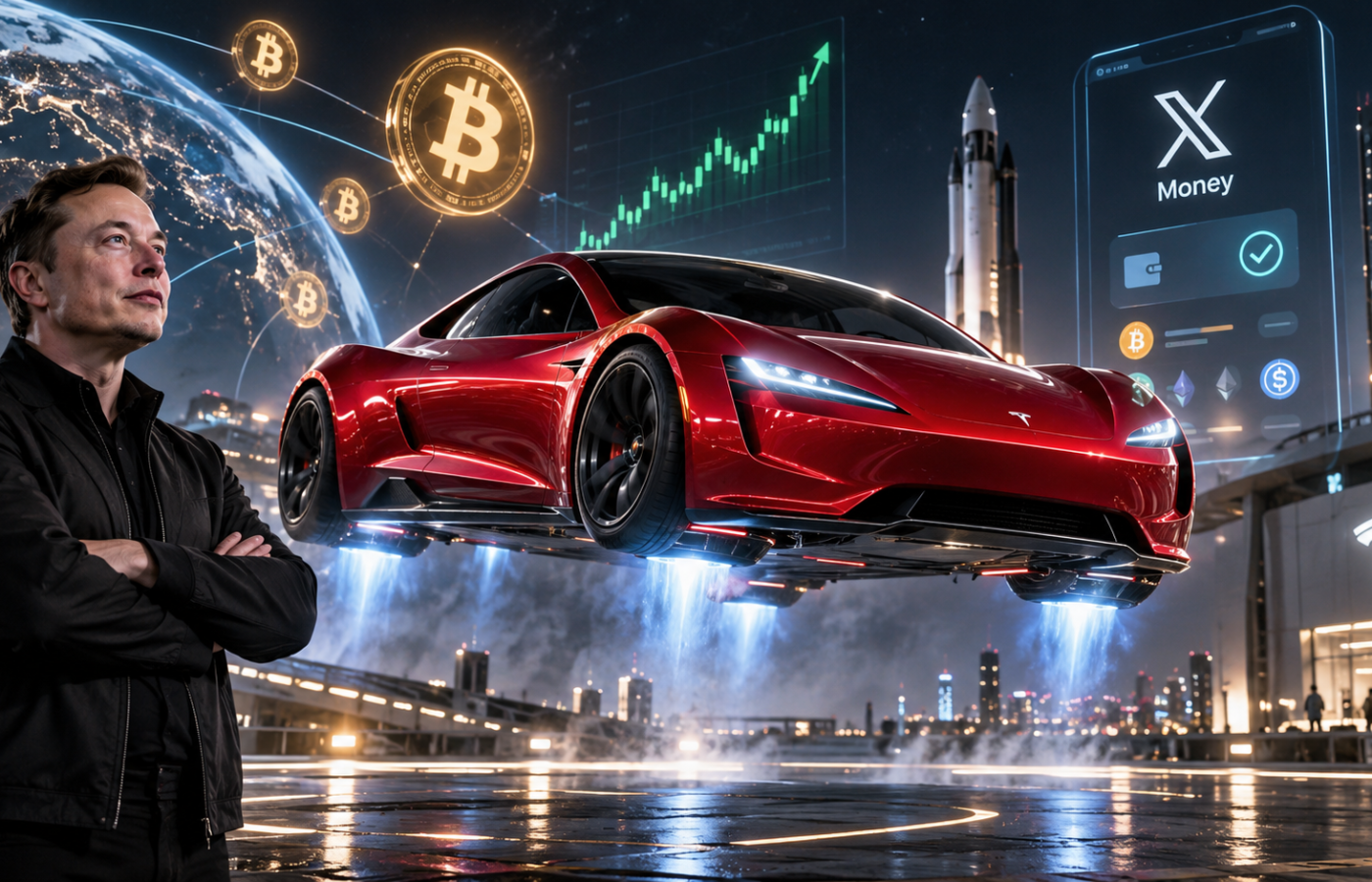
Musk Made Tesla Roadster Fly. The Stock Soared, and He’s Sitting on Another 30,000 Bitcoin

Elon Musk has surprised the world once again. The Tesla Roadster has demonstrated aerial maneuvers using SpaceX technology, while Tesla shares jumped 3.7% in after-hours trading. But behind the spectacular show lies a much more interesting financial story. Tesla and SpaceX together hold more than 30,000 Bitcoin, while social media platform X is gradually transforming into a financial ecosystem.
Tesla Roadster: Nine Years of Waiting and Its First Flight
On October 15, 2026, the next-generation Tesla Roadster was unveiled at SpaceX’s testing facility in Texas.
The vehicle demonstrated aerial flips, jumps over other cars, and maneuvering capabilities powered by compressed-gas thrusters developed with the involvement of SpaceX engineers, alongside a system of powerful fans.
The announced specifications are impressive:
- Acceleration from 0 to 60 mph (96.6 km/h) in under one second.
- Top speed exceeding 230 mph (370 km/h).
- Driving range of more than 300 miles (480 km).
- A special Rocket version equipped with additional thrusters.
However, the Roadster is not yet a fully functional flying car. These are brief aerial maneuvers rather than unrestricted flights over cities.
The next-generation Roadster was first announced back in 2017. Production has been postponed repeatedly, and Tesla now promises to begin manufacturing in 2028.
Musk himself acknowledges that the vehicle is unlikely to have a significant impact on the company’s financial performance.
Tesla Shares React With a 3.7% Jump
Before the presentation, Tesla shares closed the regular trading session on October 15 at $362.44, down 1.29%.
Following the Roadster demonstration, however, the situation changed.
According to after-hours pricing displayed by Investing.com, Tesla shares reached $375.85.
That represents an increase of $13.41, or 3.7%, compared with the previous closing price.
However, other market data providers reported a more modest reaction. It would therefore be premature to attribute a sustained increase in Tesla’s valuation solely to the Roadster presentation.
The outcome of the regular trading session on October 16 remains more important than preliminary after-hours movements.
Nevertheless, Musk once again succeeded in drawing investors’ attention to Tesla’s technological capabilities.
More Than 30,000 Bitcoin Held by Tesla and SpaceX
The story becomes even more interesting when examining the financial reports of Musk’s companies.
According to official filings submitted to the U.S. Securities and Exchange Commission (SEC), as of June 30, 2026:
- Tesla held 11,509 BTC. The original acquisition cost was $386 million.
- SpaceX held 18,712 BTC. The fair value of those holdings was reported at $1.098 billion.
Together, the two companies controlled 30,221 BTC.
Notably, SpaceX retained its 18,712 BTC despite a substantial decline in their market valuation during the first half of the year.
According to the financial statements, the estimated value of these assets fell from $1.637 billion at the end of 2025 to $1.098 billion by June 30, 2026.
Bitcoin has therefore become much more than a topic for Musk’s social media posts. It represents a real corporate asset whose value is directly exposed to cryptocurrency market fluctuations.
These are corporate holdings, not Musk’s personal Bitcoin reserves.
Dogecoin: Musk’s Favorite Joke Becomes a Payment Method
Dogecoin represents another chapter in Musk’s relationship with cryptocurrencies.
Originally created as an internet joke, the cryptocurrency gained enormous popularity partly thanks to Musk’s public support.
Today, Tesla officially accepts DOGE as payment for selected merchandise in its online store.
However, customers cannot purchase Tesla vehicles using Dogecoin. Cryptocurrency payments remain limited to specific products, and the company does not currently accept Bitcoin for merchandise purchases.
There is also no confirmed evidence that Tesla maintains substantial corporate Dogecoin reserves.
This creates an unusual arrangement: Bitcoin is held as a corporate investment asset, while Dogecoin serves as a limited commercial payment method.
X Money: A Financial Empire Without Cryptocurrency
Another Musk project worth watching closely is X Money.
In July 2026, the payment service began rolling out to X Premium and Premium+ subscribers in the United States.
Its features include peer-to-peer money transfers, Visa debit cards, cashback rewards, and interest on eligible account balances.
But there is an interesting detail.
Despite Musk’s longstanding support for cryptocurrencies, X Money has not confirmed integration with Bitcoin, Dogecoin, or stablecoins.
Instead, the platform relies on traditional financial infrastructure.
That does not rule out cryptocurrency payments in the future, but there is currently no confirmed roadmap or official timeline for such integration.
This raises an interesting question: Why would Musk need to create his own cryptocurrency if he can build a platform through which millions of users send and receive money?
Beyond Cars and Cryptocurrencies
Meanwhile, Tesla continues expanding into artificial intelligence, autonomous transportation, and robotics.
SpaceX is developing satellite infrastructure and space technologies, while X is attempting to combine social networking, information distribution, and financial services into a single ecosystem.
In October, Barclays analysts even raised the possibility of a merger between Tesla and SpaceX, pointing to their increasingly overlapping technological interests.
However, this remains an analytical scenario. No official merger decision has been announced.
Musk Is Selling the Future Again
The new Roadster perfectly illustrates Elon Musk’s approach to business.
The car was announced nine years ago. Mass production is now promised in another two years. The project’s future revenue remains uncertain, yet the demonstration alone has already attracted considerable attention from financial markets.
At the same time, Musk’s companies hold tens of thousands of Bitcoin, accept selected payments in Dogecoin, and are developing their own financial infrastructure.
The most promising opportunity may not involve launching another cryptocurrency at all, but rather controlling a platform that combines communication and payments.
Musk has demonstrated how a Tesla can leave the ground. But watching the financial infrastructure he is building on the ground may prove far more interesting.
And while the Roadster’s ambitions are relatively clear, one major cryptocurrency question remains unanswered: Does Musk intend to make digital assets the foundation of future payments, or would he rather keep Bitcoin in corporate reserves while billions of dollars in user transactions flow through his own financial ecosystem?
Sources
- Reuters: Tesla Unveils SpaceX-Powered Roadster, October 16, 2026
- TechCrunch: Tesla Reveals SpaceX-Powered Roadster
- Investing.com: Tesla Historical Stock Prices
- SEC: Tesla Second-Quarter 2026 Financial Report
- SEC: SpaceX Second-Quarter 2026 Financial Report
- Tesla: Official Dogecoin Payment Information
- Crypto.news: X Money Launches U.S. Payments
- Axios: Analysts Consider a Potential Tesla-SpaceX Merger