Telegram. The Tap-to-Earn Era Is Over

Telegram. The Tap-to-Earn era is over. Not long ago, it seemed the messenger was about to become something much bigger. Bots, Mini Apps, TON, NFTs, gifts, games, wallets, and tens of millions of users in tap-to-earn apps created the feeling that Telegram was building its own digital economy.
People were no longer opening Telegram only to send a message or read a channel. They launched games, completed tasks, collected in-app currencies, invited friends, waited for listings, and spent more and more time inside the platform. At the peak of that activity, it was easy to believe that a familiar messenger was gradually turning into a standalone ecosystem with its own services, entertainment, and money.
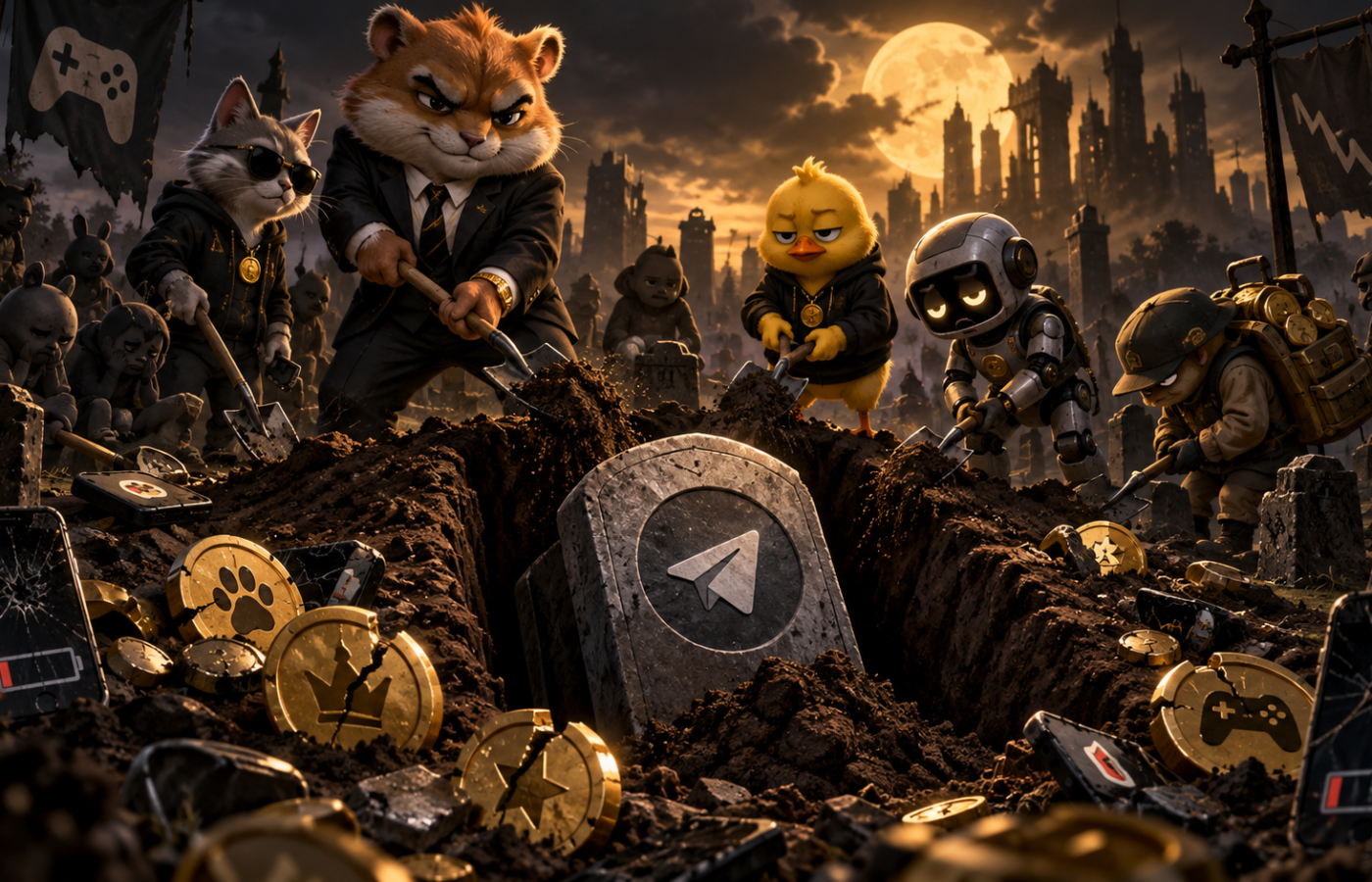
But today, most of that excitement is gone. Tap-to-Earn has largely lost its former power, users have returned to channels and private conversations, and Telegram once again looks more and more like what it originally was: a good, convenient, massive messenger — but still a messenger.
And the problem is no longer that people simply got tired of tapping the screen.
It started too well
A large part of the expectations around Tap-to-Earn were created by Notcoin.
It appeared at exactly the right moment. The mechanics were extremely simple, the barrier to entry was almost nonexistent, the audience grew at incredible speed, and most importantly, after months of playing, users actually received tokens they could sell on major exchanges.
For a large part of the audience, this was the first time virtual points inside Telegram unexpectedly turned into real money. Notcoin proved one important thing: the model could actually work.
That is why the next wave of tap-to-earn projects was received very differently. Every new project was viewed through one simple idea: if it worked once, maybe it can work again.
That belief helped Hamster Kombat grow to roughly 300 million users, while 131 million accounts were later declared eligible for the HMSTR airdrop.
The result, however, was very different.
After Notcoin, the bar kept getting lower
Hamster Kombat became one of the clearest turning points.
For months, users developed a virtual exchange, collected keys, completed tasks, invited friends, and tracked their hourly profit. Expectations were huge precisely because there was already a successful example in front of them: Notcoin.
After the airdrop, many participants discovered that their rewards were worth only a few dollars. Some allocations were so small that selling them was difficult because of minimum trade sizes on exchanges.
Discontent over distribution, user disqualifications, rule changes before the airdrop, and delayed token allocations only made things worse. One of the most anticipated launches in Telegram quickly turned into a major source of disappointment.
That was the moment the model began losing its most important asset: trust.
Notcoin taught users that the time they spent could have real value. Everything that followed gradually taught them to doubt that the next project would deliver the same result.
Projects started earning from users before users earned from them
Over time, the model itself changed.
If the original idea was simple — play for free and one day receive a token — then Mini Apps increasingly added advertising, paid upgrades, partner tasks, purchases, and different ways to speed up progress.
At some point, a very reasonable question appeared: who is actually making money from whom?
The user gives the project views, activity, referrals, and impressive user statistics. The project, meanwhile, can already monetize advertising, partnerships, and in-app purchases.
The user is still waiting for a future token.
At the peak of Tap-to-Earn, many lesser-known projects also appeared, offering users a chance to invest their own money, buy upgrades, or purchase game assets in the hope of future returns. Some of those stories ended with collapsing liquidity, abandoned development, or teams effectively disappearing.
Not every such case was deliberate fraud. But from the user’s point of view, the result often looked the same: money was invested, the promises ended, and even the original amount could no longer be recovered.
After that, the next polished presentation becomes much less convincing.
Play-to-Earn had already gone through the same cycle
Telegram was far from the first market to try building an economy around the promise of “play and earn.”
Before tap-to-earn, there was an entire Play-to-Earn era. Users were encouraged to buy gaming NFTs, spend time in games, earn tokens, and gradually recover their investment.
These economies quickly ran into one fundamental problem: if the main purpose of the product is to make money, someone has to pay for that income.
As long as new users keep arriving and bringing new capital, the model can look sustainable. Once growth slows, asset prices fall, rewards shrink, and users start leaving, the appeal of the entire system disappears along with the economy behind it.
Telegram tap-to-earn projects repeated much of the same cycle, only with easier onboarding and an audience on a completely different scale.
The audience was huge. The economy never appeared
It would be wrong to deny what tap-to-earn did for Telegram and TON.
It brought millions of people into Mini Apps, pushed users to open crypto wallets for the first time, introduced them to tokens, and demonstrated how easily a new product could spread inside Telegram without a separate installation, registration process, or complicated onboarding.
But there had to be a second stage.
A user came for the airdrop. Fine. What makes them stay after it ends? Why should they keep using a Mini App when there is no future reward? What are they willing to pay for, and what real value do they receive in return?
This is where most projects stopped.
Telegram proved that it can bring millions of people into a new product almost instantly. But bringing someone in and creating a lasting habit are two completely different tasks.
GRAM still does not give investors much peace of mind
There is another side to this story — the investment side.
After Toncoin was renamed GRAM, the asset itself did not technically disappear. But investors today care less about the name and more about token supply, future unlocks, and the potential pressure those unlocks may create.
Large and long-term unlocks still remain ahead. An unlock does not automatically mean that all released tokens will be sold immediately, but a potential buyer still sees future growth in available supply and includes that in their risk assessment.
Especially when the price of GRAM already sits far below previous highs.
The combination is uncomfortable: a weak price, more supply ahead, and the constant need to prove why the asset should be bought now rather than after the next unlock.
For a long-term investor, this is a serious psychological factor. Even someone who believes in Telegram and TON can rationally decide that there is no reason to hurry.
There have already been too many promises
Over the past few years, Telegram users have repeatedly been shown the next big phase.
First, NFTs were supposed to unlock a new economy. Then came gaming projects, Tap-to-Earn, Mini Apps, new tokens, collectible gifts, wallets, and dozens of other ideas.
Some of that genuinely launched and continues to work. But at the same time, too many stories accumulated where expectations were far greater than the final result.
There were tokens that lost value sharply after listing, projects with weak liquidity, rule changes, failed promises of future utility, and cases where teams simply disappeared from public view after raising money.
Every case had its own reasons. Sometimes tokenomics failed. Sometimes the product never materialized. Sometimes the marketing budget ran out. And sometimes there were clear signs of outright fraudulent behavior.
But the average user does not investigate every single project.
They form an overall impression of the ecosystem.
And that overall impression is now becoming one of the biggest problems.
The scandals never disappeared either
All of this exists alongside a constant stream of controversy around Telegram, TON, and related projects.
Hacks, bridge failures, outages in individual services, legal issues, disputes around token distribution, and projects that gather enormous audiences only to slowly disappear from view.
No single incident destroys an ecosystem.
But together, they gradually erode trust among both investors and ordinary users.
For the mass audience, Telegram, TON, GRAM, Mini Apps, wallets, and games are often perceived as parts of one large ecosystem. Users are not required to understand which specific team is responsible for which project. They remember the overall result.
And the overall result of the last few years has been far too mixed.
Telegram gained an audience, but not a new habit
A real ecosystem does not begin when a user arrives for a reward. It begins when they return without one.
People open YouTube because they want to watch videos. Spotify because they want to listen to music. Steam because they want to play games. Marketplaces because they want to buy things.
Why does someone open Telegram today, apart from messaging and reading channels?
The answer is mostly the same as it was years ago.
All the other features exist around that core, but none of them has yet become a strong enough independent reason to radically change how people use Telegram.
That is the line separating a huge audience from a real digital economy.
The next tap-to-earn game will not change anything
The market is still trying to recreate the success of Telegram’s first gaming wave. A new mechanic appears, then a new bot, a new token, and a new referral program.
But users have already seen Notcoin.
And then they saw everything that came after it.
That means repeating the same model is no longer enough.
The next truly major product inside Telegram cannot simply be a better tap-to-earn game. It needs to give people a completely different reason to spend time there.
It could be a game, a service, a social mechanic, trading, digital identity, a real internal economy, or something that does not even exist yet.
The format matters less than the value.
Not a future token. Not a listing promise. Not a referral link. Not a possible reward several months from now.
Something has to be useful or interesting to the user today.
What are we actually waiting for from Telegram?
Telegram has already proven that it can bring millions of people into a new product almost instantly. Notcoin showed how powerful that model can be, while the Tap-to-Earn wave that followed demonstrated its limits.
Now the challenge is completely different.
The audience has become more experienced, more cautious, and far less responsive to promises of future earnings alone. At the same time, investors are looking at GRAM’s price, future unlocks, and the accumulated risks around the ecosystem.
Telegram still has something most blockchains do not: a massive ready-made audience.
But the main question today is no longer how many people Telegram can bring inside.
The main question is what it can offer them that will make them want to stay after everything that has already happened.
Sources
WIRED — Hamster Kombat and Telegram gaming boom
BeInCrypto — Why the Hamster Kombat Airdrop Failed
DeFiLlama — TON / GRAM Token Unlocks