Gram Wallet Is Live: Telegram Begins Building a New Crypto Infrastructure

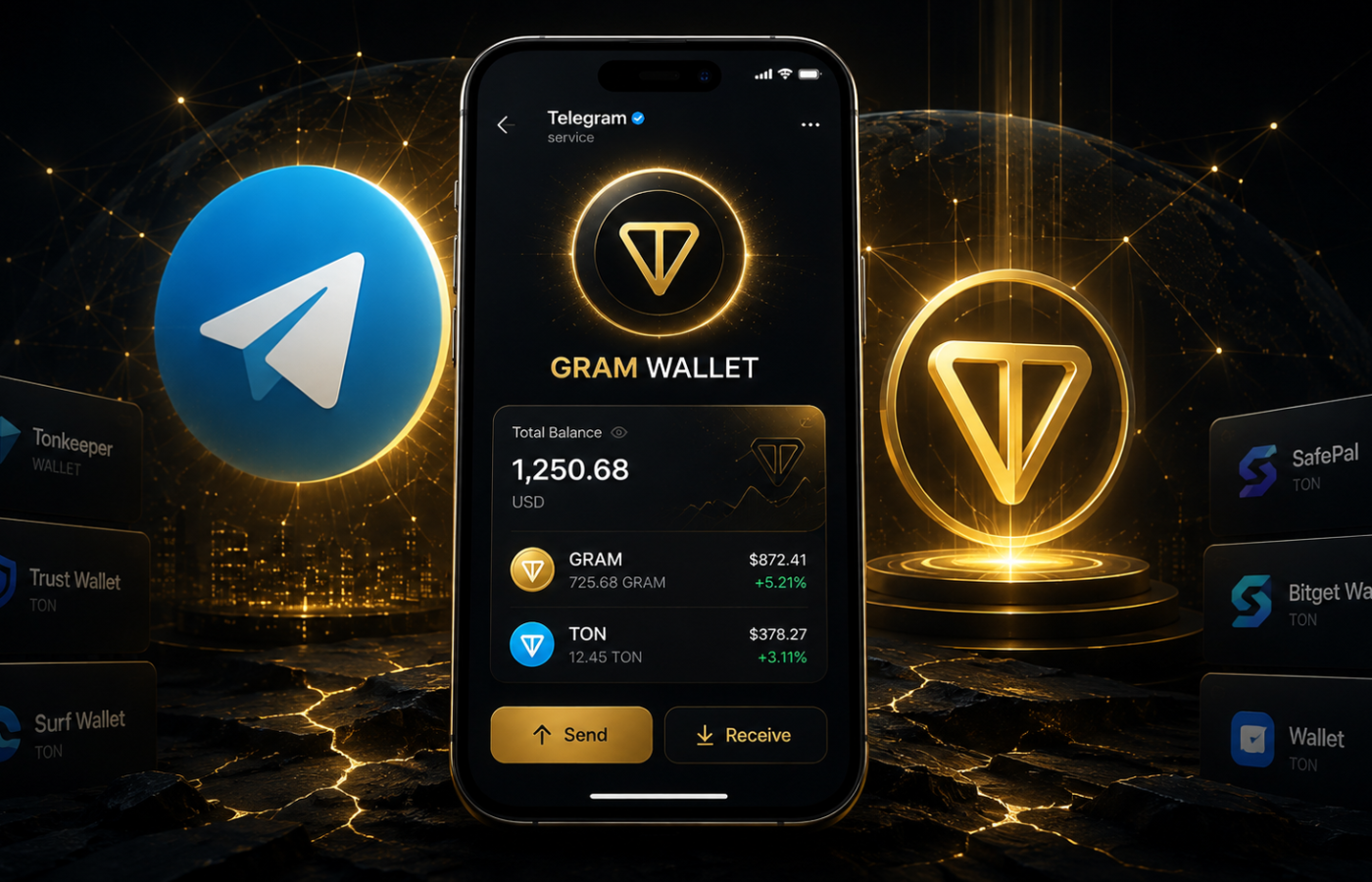
On August 31, Pavel Durov announced that Gram Wallet is ready and already available to the first limited group of Telegram users. Over the following two weeks, the wallet is expected to gradually roll out to the messenger’s audience of more than one billion users.
The key point is not just the launch itself. Before the rollout, TON validators approved a new smart contract architecture that allows Gram Wallet to be updated in the future without forcing users through mass wallet migrations. At the same time, the existing Wallet in Telegram is beginning to transition into a separate product under the Walt brand.
This effectively creates two different crypto layers inside Telegram: a simple native self-custody wallet for everyday use, and a separate platform for trading, investing and more advanced asset management.
Gram Wallet Moves From Announcement to Launch
Durov first announced preparations for Gram Wallet in July. At the time, it was described as a native non-custodial wallet integrated directly into Telegram applications and designed for a mass audience.
On August 31, the product moved into a limited launch phase.
Durov said that Gram Wallet is already working for the first group of users, with a broader rollout expected to take place gradually over roughly two weeks.
For now, this refers to the availability of the feature rather than one billion active wallets. The actual scale of adoption will only become clear after the rollout is completed.
TON Changed Its Architecture for Gram Wallet
An important technical detail emerged alongside the launch.
TON validators approved a network-level change known as Config -123, connected to the architecture of the new wallet.
Instead of storing the full logic separately inside every individual user smart contract, the system allows part of the shared wallet logic to be moved to the network level. The user contract can therefore remain small and persistent.
This makes it possible to update Gram Wallet functionality without requiring mass migration to new contract versions or forcing every wallet holder to move funds manually.
For a product designed for a very large audience, this is critical. Users should not have to understand smart contract versions or move assets after technical upgrades.
The new architecture is designed to remove that problem.
Gram Wallet and Walt Will Serve Different Purposes
At the same time, the role of the existing Wallet in Telegram is changing.
The service is beginning to move under the new Walt brand and is expected to focus on a broader set of crypto functions.
Gram Wallet, in contrast, is positioned as a simpler native self-custody wallet for everyday use.
The division effectively looks like this:
Gram Wallet — storage, transfers, payments and basic operations inside Telegram.
Walt — trading, investment tools, multichain functionality and more advanced crypto asset management.
This split allows Telegram to avoid overloading its main wallet with features that most ordinary users may never need.
Self-Custody Becomes Part of Telegram Itself
The main difference between Gram Wallet and most crypto wallets is distribution.
Users do not need to search for a separate application, install a browser extension or move to an external service.
The wallet becomes part of Telegram itself.
This removes one of the main barriers to mass crypto adoption: the need for users to enter a separate blockchain environment on their own.
At the same time, the model remains self-custody. Users are expected to retain control over their own funds, while Telegram provides the interface and infrastructure.
How convenient this model proves in practice will become clearer after the full rollout.
The Recovery Question Is Still Open
For a mass-market self-custody wallet, one of the biggest challenges remains account recovery.
The traditional seed phrase model is poorly suited to the audience of an ordinary messenger. Losing the phrase can mean losing the funds, while securely storing a set of recovery words remains a significant barrier for mainstream users.
Durov has said that Gram Wallet includes solutions designed to simplify the use of non-custodial wallets, but the full details of the recovery mechanism have not yet been made public.
This will be one of the most important elements to watch after the rollout is completed.
What Changed After Our Platho Investigation
Kljompus previously examined Platho and the development of infrastructure around Telegram, TON and Gram Wallet.
At that time, Gram Wallet was still only an announced product, and the main question was how deeply a native wallet could eventually become integrated into Telegram itself.
After August 31, one of the key parts of that structure became real.
A native self-custody wallet has begun appearing directly inside Telegram, while the network was prepared in advance so that the wallet can be scaled and upgraded without mass user migrations.
There is still no official confirmation of any direct connection between Platho and Telegram, so there are no grounds to treat it as part of the Gram Wallet structure.
But the launch itself confirms that Telegram is indeed moving blockchain infrastructure from a separate service into a native feature of the messenger.
What Is Still Unknown
Several important questions remain unanswered.
It is not yet clear how actively users will create and use Gram Wallet after the mass rollout.
The full recovery mechanism has not been disclosed.
It is also unclear how broad the feature set inside Gram Wallet will become, and which operations will remain exclusive to Walt.
And for now, it is impossible to measure how strongly the new product will redistribute users across the existing TON wallet market.
That may become one of the most important consequences of the launch.
Kljompus Takeaway
The launch of a full-scale Gram Wallet inside Telegram changes more than the messenger itself.
It changes the balance of power across the entire TON ecosystem.
Until now, users had to choose between Tonkeeper, MyTonWallet, Wallet and dozens of smaller solutions created by individual projects. Each had its own audience, its own functionality and its own place in the ecosystem.
Now there is a wallet that comes built directly into Telegram and is potentially available to more than one billion users.
And that is where the most interesting question begins.
How much demand will remain for third-party wallets if basic GRAM operations can be handled directly inside the app people already use every day?
For larger players, this is not necessarily a death sentence. They can still compete through functionality, DeFi, multichain support, professional tools, more flexible asset management and access to services that may never appear inside Gram Wallet.
But the situation looks much more difficult for smaller wallets created by individual projects.
If their main advantage was simply convenient access to TON, transfers and token storage, that may no longer be enough once Telegram offers its own native wallet.
They will have to explain why a user should install another app, create another wallet and move funds there if everything essential is already available inside Telegram.
This is where Gram Wallet may have a far greater impact on the ecosystem than it appears to today.
Sources
Pavel Durov — Gram Wallet rollout
Pavel Durov — Gram Wallet announcement
TON Strategy Company — Config -123 and Gram Wallet infrastructure