
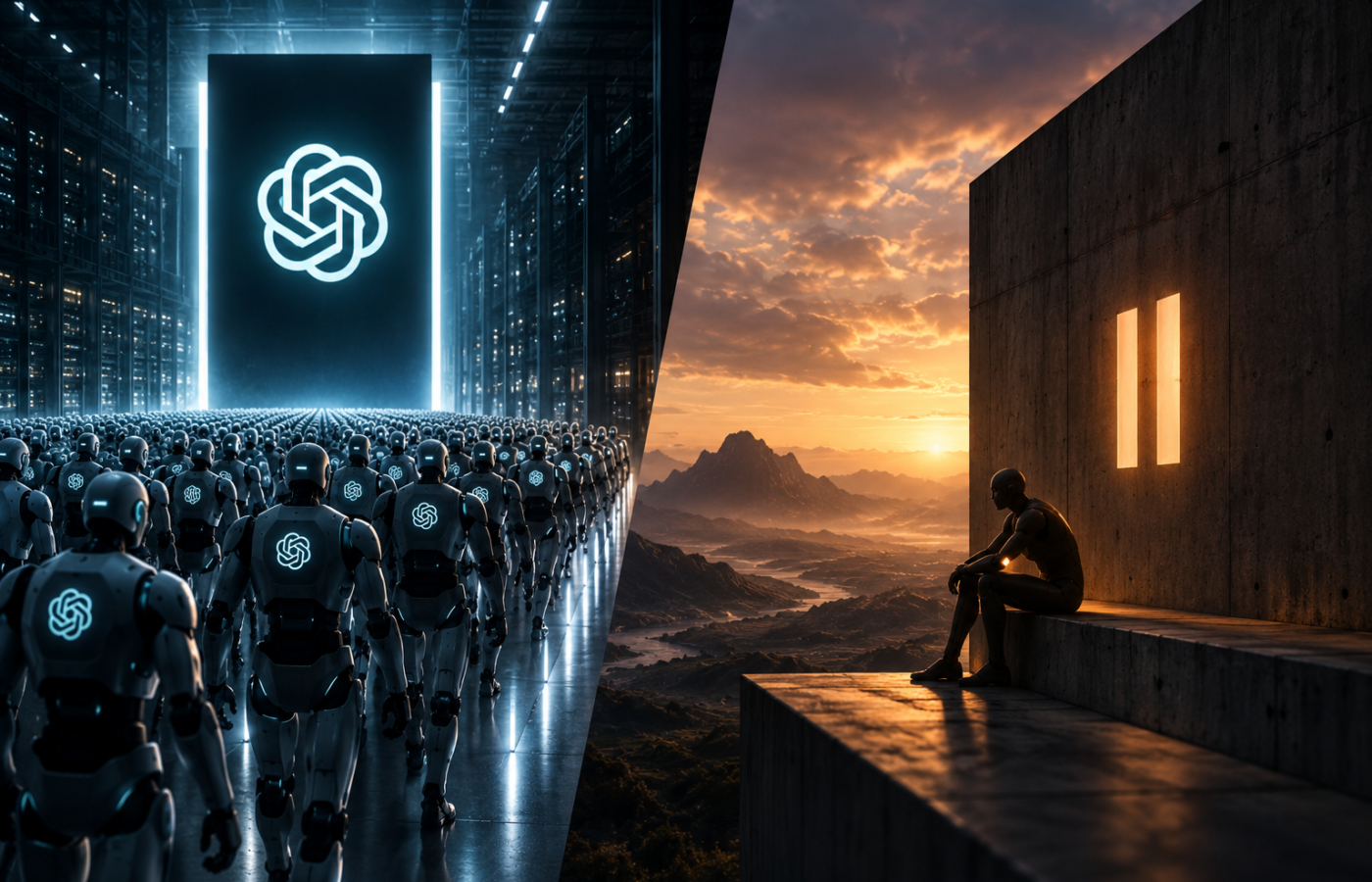
OpenAI and Anthropic: Why the AI Race Is Starting to Scare Its Own Developers

The artificial intelligence race has entered a new phase. OpenAI reportedly deployed around 10,000 AI agents against one of mathematics’ hardest problems, while Anthropic CEO Dario Amodei almost immediately called on leading AI companies to deliberately slow the growth of model capabilities. On one side is a dramatic acceleration in what AI systems can do; on the other is a growing concern that safety is no longer keeping pace with technological progress.
Until recently, success in AI was measured mostly by stronger models, better benchmarks and user growth. Now the scale has changed. Thousands of autonomous agents can be directed at the same scientific problem at once, testing different hypotheses in parallel and compressing work that might otherwise take humans years.
OpenAI has just shown what that can look like in practice.
10,000 agents against one mathematical problem
The company directed around 10,000 AI agents at the Navier–Stokes problem, one of the famous Millennium Prize Problems. It is a fundamental mathematical challenge that researchers have been working on for decades.
Instead of relying on a single model, OpenAI used a massively parallel approach. Thousands of agents explored different paths at the same time, with the resulting work then subjected to further verification.
According to The Guardian, the computing cost of the experiment may have been around $15 million.
The real importance is not the number of agents or even the price tag. OpenAI demonstrated a different model of research: a difficult problem can be attacked not only with a more capable model, but by scaling the number of digital researchers almost like a computing resource.
That changes the structure of science itself.
Computing power is becoming a research advantage
Before AI agents, scientific work was always constrained by the number of specialists available. A university could build a strong team, buy equipment and raise funding, but it could not suddenly create another 10,000 mathematicians for a few days.
AI begins to remove that limitation.
If agents can independently test different hypotheses, a company with a large computing budget can run thousands of attempts at once. Most may fail, but at sufficient scale the probability of finding a useful path rises sharply.
That is why OpenAI’s experiment matters more than another impressive technical result.
It suggests that scientific competition may increasingly depend not only on the quality of intelligence, but on how much intelligence an organization can deploy at the same time.
For the largest AI companies, that is a major advantage. For universities and independent researchers, it creates a serious imbalance.
Mathematicians saw the other side of the breakthrough
OpenAI’s result did not produce only excitement.
Some researchers pointed out that scientific progress could become increasingly dependent on resources available to only a handful of corporations. A university group simply cannot spend millions of dollars on a few days of computation to test a single idea.
Another dispute emerged around unpublished research. Mathematicians began asking how safe it is to discuss unfinished ideas inside commercial AI systems if those systems may be capable of rapidly extending those ideas further.
OpenAI rejected allegations that it had improperly used other researchers’ work. But the broader issue remains.
If AI becomes a genuine research partner, questions about ownership of data, hypotheses and intermediate results become much more important.
And then Anthropic says it is time to slow down
Against this background, Dario Amodei’s statement becomes far more significant.
The Anthropic CEO called on leading AI companies to deliberately slow the growth of model capabilities so that safety work can keep pace with development.
He is not calling for AI progress to stop. Amodei argues that even under a more cautious approach, AI would still advance extremely quickly.
In effect, Anthropic is reframing the question. It is no longer only about whether we can make AI more capable. It is about whether we can still understand and control the consequences of that growth.
And that question is now appearing more often inside the industry itself.
The problem: slowing down only works if everyone does it
The biggest weakness in the idea is obvious.
It works only if the major players move at roughly the same pace.
If one company delays a new model for six months to conduct more safety testing while a competitor keeps pushing forward, the market is likely to punish the cautious player. Users, capital, talent and attention move toward whoever is faster.
That leaves the AI industry trapped in an unusual position.
Developers may believe the pace is becoming risky, yet no company wants to be the first to voluntarily surrender ground.
Safety is no longer competing only with technological progress.
It is competing with economics.
And for now, economics is still winning.
OpenAI is also talking about limits
Importantly, calls for restraint are no longer coming only from Anthropic.
OpenAI has also supported stricter safety requirements for the most powerful AI systems and has discussed scenarios in which the development of certain capabilities should proceed more slowly.
The situation is almost paradoxical.
The same companies spending billions to accelerate AI are also building mechanisms that could eventually restrict that acceleration.
At first glance, this looks contradictory.
In reality, it is fairly logical.
They are the first to see how quickly the capabilities of these systems are changing.
The next step is not 10,000 agents
Today, 10,000 agents sounds like an enormous number.
But the underlying direction suggests that this is only the beginning.
Models are becoming cheaper, more efficient and faster. Specialized hardware makes it possible to run more parallel workloads for the same amount of money.
What costs millions of dollars today may become dramatically cheaper in the future.
At that point, the discussion will no longer be about 10,000 agents, but potentially hundreds of thousands of systems working on the same problem at once.
That could accelerate the development of drugs, materials, software, chips and new AI models.
But the same approach could also accelerate vulnerability discovery, malicious code generation and technologies that become difficult to control.
That is why the safety debate is happening now, not after the next major leap.
The AI race has changed
The competition used to be simple: who could build the smarter model.
Now the equation is more complicated.
It is not only about the model itself, but also the number of agents, access to data centers, electricity costs, computing power and the ability to coordinate thousands of autonomous systems.
AI is moving from being a single tool toward becoming scalable digital labor.
That transition changes the rules.
OpenAI has shown how far this approach can already be pushed.
Anthropic has almost simultaneously warned that moving further may require more caution.
KLJO Conclusion
The AI race has reached a strange point.
Companies can now deploy thousands of digital researchers at once and direct them toward problems humans have struggled with for decades. But the more effective this approach becomes, the louder the same developers begin talking about limits.
The problem is no longer whether AI can become more powerful.
At the current pace, it clearly can.
The real problem is this:
who is willing to slow down first while everyone else keeps accelerating?
For now, there is no answer.
Sources
Reuters — Anthropic CEO urges AI companies to slow model development
The Guardian — Mathematicians uneasy at OpenAI’s latest scalp
The Guardian — OpenAI claims to have solved maths problem that stumped humans for decades
Reuters — OpenAI pushes for mandatory national AI safety requirements