
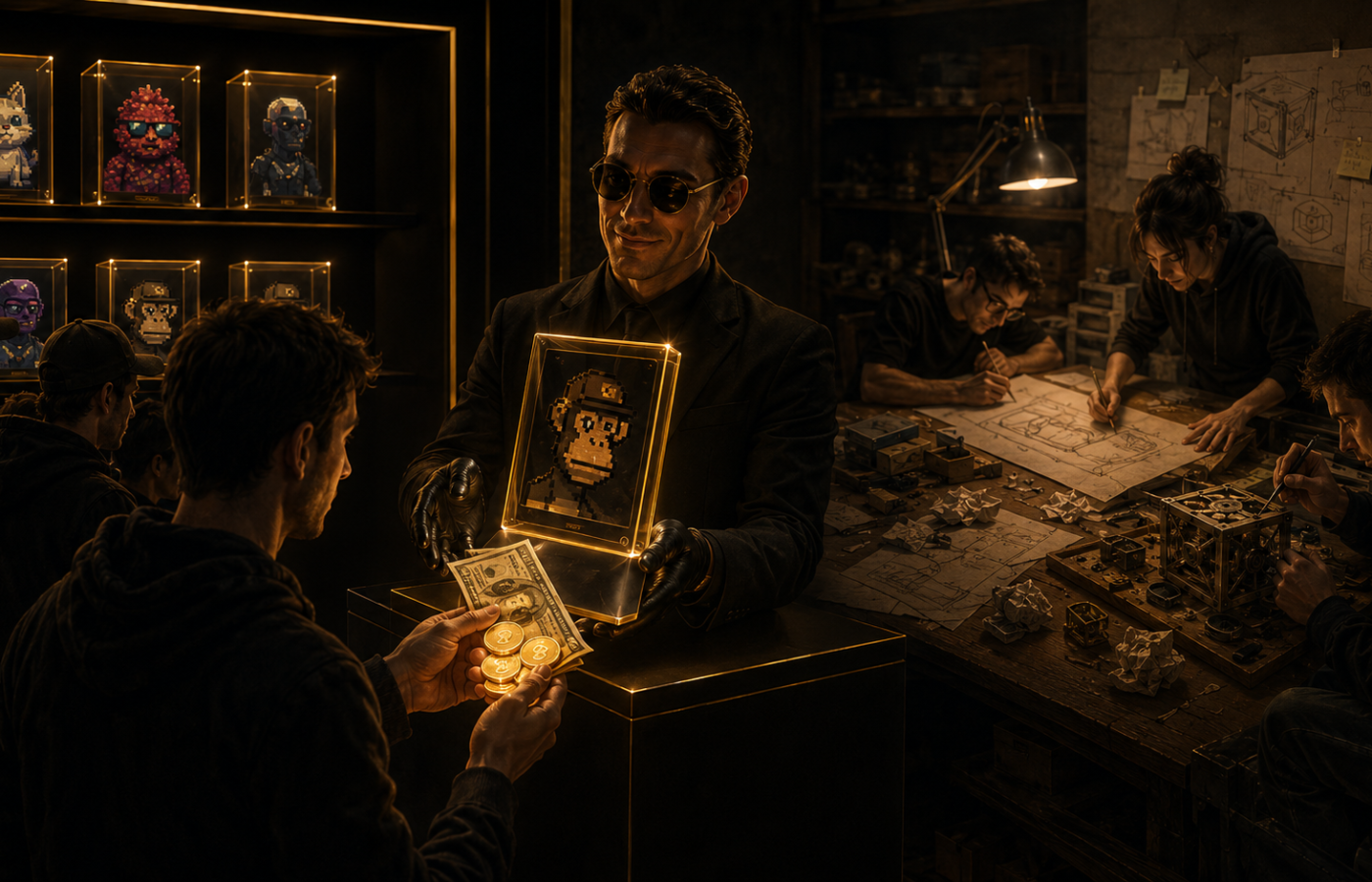
Money first. Then meaning.

In many blockchain projects, this is increasingly the order of things: money first, meaning later. First, they sell NFTs, stickers, passes, collectibles, and other digital assets to their audience, and only later do they explain why all of this will be needed. The project generates revenue immediately, while utility, practical application, and real value remain somewhere down the road. And the more often this pattern repeats, the more important it becomes to understand whether a real product is being built here or whether it’s just a constant sale of promises of the future.
Who's really paying here?
The release of NFTs or other digital products is not a problem in and of itself. People may buy collectibles simply because they like them, or as a way to support the team.
The problem arises when such sales become one of the project's main sources of revenue, and its own community is, time and again, the primary buyer.
A project launches a new product, builds hype around it, motivates people to buy, makes money, and then, after a while, launches the next sale. Technically, there is revenue, but there’s a big difference between making money from a product in high demand and consistently monetizing your own audience.
If a user pays for a service, infrastructure, fee, subscription, or a specific feature, it's clear: they receive a working product and pay to use it.
If, on the other hand, a person buys an asset that is promised to have additional features added later, a different model emerges. The project receives the money now, while the buyer receives a promise.
When they sell first and look for a use later
One of the most noticeable signs is when a digital product appears before its intended function.
The NFT is already available for purchase, but its utility will come later. The stickers are already on sale, but their role within the ecosystem is still taking shape. A new digital item has been released, but it doesn't have a specific use yet.
This raises a simple question: if the app is truly an important part of the product, why not develop that feature first, and then ask people to buy it?
When a sale takes place before the product delivers value, the buyer is effectively financing the promise.
It’s especially problematic when the utility is constantly pushed back: after an update, after the app launches, after the game is released, after integration, or after the next phase of the roadmap. The team receives the money right away, but fulfilling those promises is left for the future.
When Urgency Is Sold Instead of Value
It's worth taking a closer look at exactly how the project motivates people to buy.
Limited quantity, available only to early adopters, last chance, a rare item, this edition will never be produced again—all of these can have a much stronger impact than the product description itself.
If someone explains in much greater detail why you should buy something right now, rather than why you need it at all, that's a reason to be more cautious.
The same applies to situations where people constantly discuss an asset's value, rarity, mint price, floor price, and potential growth, but talk far less about its practical applications.
In this model, value increasingly depends on whether the next buyer will come along.
And who are you going to sell it to afterward?
The existence of a marketplace does not necessarily mean there is a real secondary market.
An NFT can be listed for sale at any price, but a transaction requires a buyer. That’s why it’s more important to look not at a high floor price, but at actual sales, trading volume, the number of buyers, and the frequency of transactions.
It is particularly risky when the entire market is effectively confined within the project itself. The same participants buy assets from one another, discuss them in the same channels, and generate demand within a single community.
As long as new people are joining the project, this model can work. But if the influx of participants stops, the pool of potential buyers shrinks dramatically.
And so the main question is very simple: who will buy this asset from you if everyone interested is already part of the project and most of them have already bought something?
If there is virtually no external demand, the secondary market depends directly on a steady influx of new participants.
When a project is constantly in need of new people
Every business needs new users to grow. But there’s a big difference between growth and dependence.
If existing users are paying for a product they actually need, the project can continue to operate even if growth slows down.
It’s a completely different situation when new participants are needed primarily because someone has to buy the next batch of NFTs, stickers, or passes—or acquire assets from previous owners on the secondary market.
In that case, the economy begins to depend on a constant inflow of new money.
That's a serious warning sign. Once you factor out new customers, it becomes clear to what extent the project can sustain itself through its core product.
When Every New Stage Turns into a Sale
You should also be wary when almost every stage of a project is accompanied by a new offer to buy something.
A new season, an update, new mechanics, a new role, a new event—and along with them comes a new digital item.
That in itself doesn't prove anything. But if this pattern keeps repeating itself, it's worth examining what exactly is the main driving force behind the project: the technology and the service, or the ability to regularly sell something to its own community.
For the same reason, the volume of domestic sales should not automatically be taken as proof of a healthy economy. A project might sell NFTs worth hundreds of thousands of dollars, but this primarily reflects how much money its audience has spent.
What's far more important is this: Is there demand for the core product without the next drop, and is anyone outside the project's own community paying for it?
When a Community Becomes a Cash Register
The most unpleasant moment comes when a project increasingly treats its audience primarily as a source of money.
Buy a new item, support the next launch, participate in a drop, get future perks, and don't miss out on a rare release.
It's fine to support a project. It's also fine to buy collectibles. But users need to understand exactly what they're getting for their money.
If it's explicitly stated that the purchase is intended solely to support the team and there are no additional promises, the situation is clear.
If the sale is based on the project’s future utility, benefits, ecosystem development, and potential value, then the buyer is already assuming the risk that all of this will actually materialize.
The project has already received the funding. The rest has yet to be implemented.
What to Look for Before Buying
Before purchasing such an asset, it’s enough to check a few things: whether it has a use case right now, who is bringing in revenue for the project besides its own community, whether there are actual sales on the secondary market, whether there is demand outside the project, and whether the economy can function without a constant influx of new participants.
If almost everything depends on the project's future utility, new drops, and the arrival of the next wave of buyers, the risk is quite obvious.
In that case, the user isn't so much buying a finished product as they are buying into the belief that the team will eventually deliver on its promise—but what if they don't? What then?
Conclusion KLJO
Take another look at all your assets and try to evaluate them objectively. Why did you invest in them in the first place? What exactly did you buy—a working product, a real function, or a promise of future value? Does this asset have a real secondary market? Are there external buyers? And will you really be able to sell it whenever you want?
And most importantly—ask yourself a simple question: Do you really expect to make money on this asset, or are you just hoping that someone else will come along after you and buy it for more?
Sometimes, just one such review is enough to make you look at your own portfolio in a completely different light.
опередил, хотел тоже самое написать