
Ledger Packed With Fraudsters’ Hardware

Your cold wallet could turn out to be a spy. And it doesn’t even need access to your internet connection to steal your keys. A hidden LTE module could be enough to intercept a seed phrase directly from the screen and transmit it to attackers. Former Mt. Gox CEO Mark Karpelès has revealed what appears to be a hardware implant, while Ledger is investigating reports of cryptocurrency losses worth tens of millions of dollars.
The most disturbing part is that a modified device could still look authentic, pass genuine-device verification, and function like an ordinary hardware wallet. Its owner might never suspect that their primary security tool has been turned into a surveillance device.
A Spy Inside Ledger
On October 9, Mark Karpelès, the former CEO of the infamous Mt. Gox cryptocurrency exchange, presented components that he claims were discovered inside a modified Ledger hardware wallet.
This is not about malicious software, a fake website, or an infected computer. The suspected attack involves physically modifying the device itself.
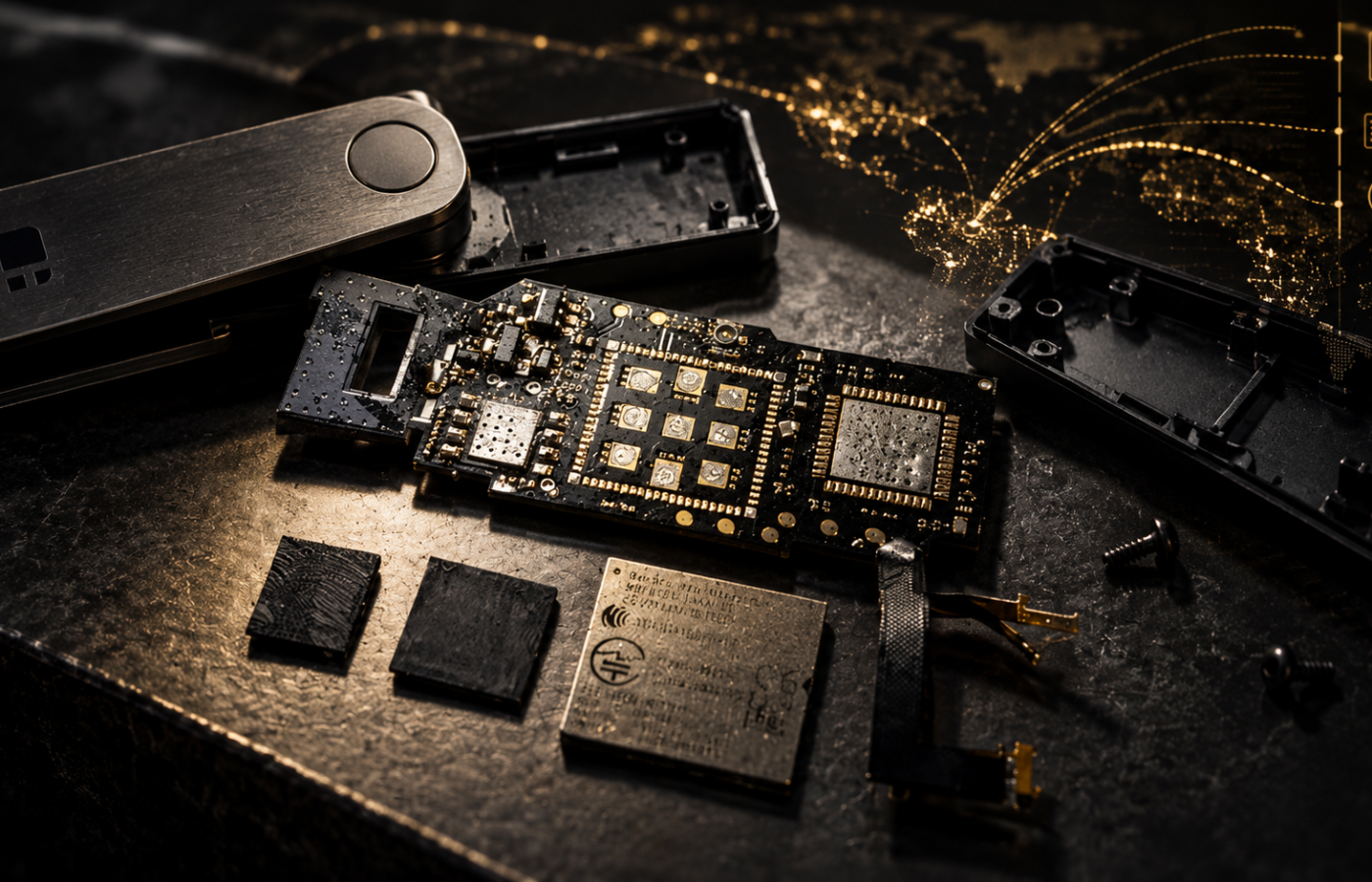
The published images show additional electronics, a microcontroller, a cellular communication module, and components designed to connect to the wallet’s internal circuitry.
According to Karpelès, the device came from Malaysia, and its packaging showed no obvious signs of tampering.
The unauthorized electronics were reportedly hidden beneath the display, in an area normally occupied by protective padding.
In other words, a buyer could potentially receive a genuine Ledger device equipped with additional functionality that neither the manufacturer nor the owner knows exists.
How Seed Phrase Interception Works
The proposed attack mechanism is both simple and extremely dangerous.
During initial setup, a hardware wallet generates a secret recovery phrase, typically consisting of 24 words.
This sequence allows the recovery of private keys and access to cryptocurrency assets.
The user writes down the words, believing they will never leave the wallet’s protected environment.
However, the spy module does not necessarily need to penetrate the secure chip.
According to Karpelès, an additional microcontroller connects to the SPI (Serial Peripheral Interface) bus, which carries information to the device’s display.
It analyzes the transmitted data, reconstructs the displayed characters, and identifies the words appearing on the screen.
Once the complete sequence has been captured, the LTE module could potentially transmit it to attackers over a cellular network.
The attack would unfold as follows:
- The user turns on the Ledger and begins the setup process.
- The device generates and displays the recovery words.
- The hidden module intercepts the data being sent to the display.
- The microcontroller recognizes the words and reconstructs the seed phrase.
- The LTE module can potentially transmit the secret sequence over a cellular network.
All of this could happen without any visible changes to the wallet’s normal operation.
The critical danger is that attackers do not need to compromise the Secure Element, the protected chip designed to store cryptographic secrets.
They only need to access the information as it is being displayed to the user.
However, demonstrating that such interception is technically possible is not the same as proving that this particular implant successfully transmitted a complete seed phrase. Public independent evidence confirming the full operation of the discovered implant remains limited.
Why Genuine Check May Not Protect You
Ledger uses a mechanism called Genuine Check, designed to verify the authenticity of its devices.
However, this system has an important limitation.
It verifies the authenticity of the Secure Element and certain aspects of the software environment, but it is not a complete physical inspection of every electronic component.
If the original Secure Element remains intact while an unauthorized module is connected to the display circuitry, a standard authenticity check may fail to detect the hardware modification.
This creates a particularly troubling situation.
The firmware is genuine. The secure chip is authentic. The cryptography works. The device passes verification.
Yet unauthorized electronics could still be hiding inside, monitoring the owner’s actions.
This is a classic supply chain attack, where a device is compromised before reaching its final user.
$86 Million and Ledger’s Investigation
As reports about the hardware implant circulated, another scandal began to unfold.
On October 9, reports emerged that Ledger was investigating cryptocurrency losses involving users in Southeast Asia who had purchased devices through the reseller CryptoBilis.
According to published information, Ledger asked the reseller to temporarily suspend sales and shipments while the investigation was underway.
CryptoBilis had appeared on Ledger’s lists of authorized resellers in the region.
Meanwhile, on-chain investigators began examining suspicious cryptocurrency movements.
Researcher tanuki42 estimated potential losses exceeding $72 million. Another analyst, Specter, placed the combined value of suspicious transactions above $86 million, including activity across the Bitcoin, Ethereum, and Tron networks.
However, confirmed facts must be separated from speculation.
As of publication, no direct causal connection has been established between the modified Ledger demonstrated by Karpelès and the suspicious transactions involving $86 million.
It remains unknown how many devices may have been modified, who carried out the alterations, or whether all the reported incidents are connected.
Furthermore, Karpelès himself did not claim that the device he examined had been purchased directly from CryptoBilis.
The timing of these developments raises serious questions, but coincidence alone is not technical evidence.
What Ledger Owners Should Do
Users who purchased devices from resellers involved in the investigation should pay particular attention to the situation.
If there are reasonable grounds to suspect that a hardware wallet has been physically compromised, its existing seed phrase should be treated as potentially exposed.
Recommended precautions include:
- Do not initialize or configure a suspicious device.
- Do not restore an old seed phrase on a new wallet if that phrase may have been compromised.
- Generate an entirely new recovery phrase on a trusted device.
- Transfer assets to new addresses controlled by the new seed phrase.
- Never enter recovery words into websites claiming to verify Ledger security or provide compensation.
Purchasing directly from the manufacturer and checking packaging integrity may reduce supply chain risks, but neither provides an absolute guarantee against hardware tampering.
At the same time, the discovery of a suspected implant does not mean that all Ledger devices are vulnerable or that every owner is at risk.
Cryptography Wasn’t Broken. It Was Simply Bypassed.
The significance of this story extends far beyond the potential loss of tens of millions of dollars.
For years, the cryptocurrency industry has emphasized that hardware wallets keep private keys isolated from computers, browsers, and potentially infected devices.
Secure Elements, protected displays, firmware verification, and cryptographic attestation have become the foundation of trust in cold storage.
But every security architecture relies on one fundamental assumption: the device received by the user actually matches the manufacturer’s intended design.
A hardware implant attacks that assumption directly.
It does not brute-force private keys, break Bitcoin or Ethereum, or defeat the mathematical foundations of blockchain cryptography.
It simply observes the moment when the wallet itself displays its most sensitive recovery information to the owner.
If the described attack receives full technical confirmation, hardware wallet manufacturers will need to pay even greater attention not only to software security but also to component integrity, manufacturing processes, supply chains, and physical device protection.
Because the most dangerous wallet isn’t the one that stops working. It’s the one that works perfectly for two people.
Sources
- Mark Karpelès (@MagicalTux), X — Publications concerning the suspected hardware implant.
- Crypto Briefing: Ledger Users Warned of Potential Implant in Malaysian Devices — Photographs and technical details of the suspected device.
- The Block: Ledger Investigates Wallet Drains, Losses Estimated Above $86 Million — Investigation details and estimates from on-chain analysts.