
The Great Oxygen Catastrophe: Were Our Ancestors Immortal Until Plants Poisoned Them?

We’ve grown accustomed to thinking of oxygen as synonymous with life. Without it, a person dies in a matter of minutes. But the Great Oxygen Catastrophe, which occurred about 2.4 billion years ago, reveals another side of this gas: for the vast majority of organisms that existed at the time, the emergence of free oxygen marked a deadly change in the environment. Without it, a person dies in a matter of minutes. But what if we look at evolution from a different angle? What if the gas we eagerly breathe in every second is actually a slow-acting poison that kills us over the course of 70 to 80 years?
Scientific data on the early Earth, cellular aging, and prenatal development reveal a paradoxical picture: it is possible that, long before we arrived, the planet was inhabited by nearly immortal creatures that breathed carbon dioxide. And then plants appeared, launching the most massive chemical assault in the planet’s history.
Dossier No. 1: The Green Virus and the First Mass Extinction
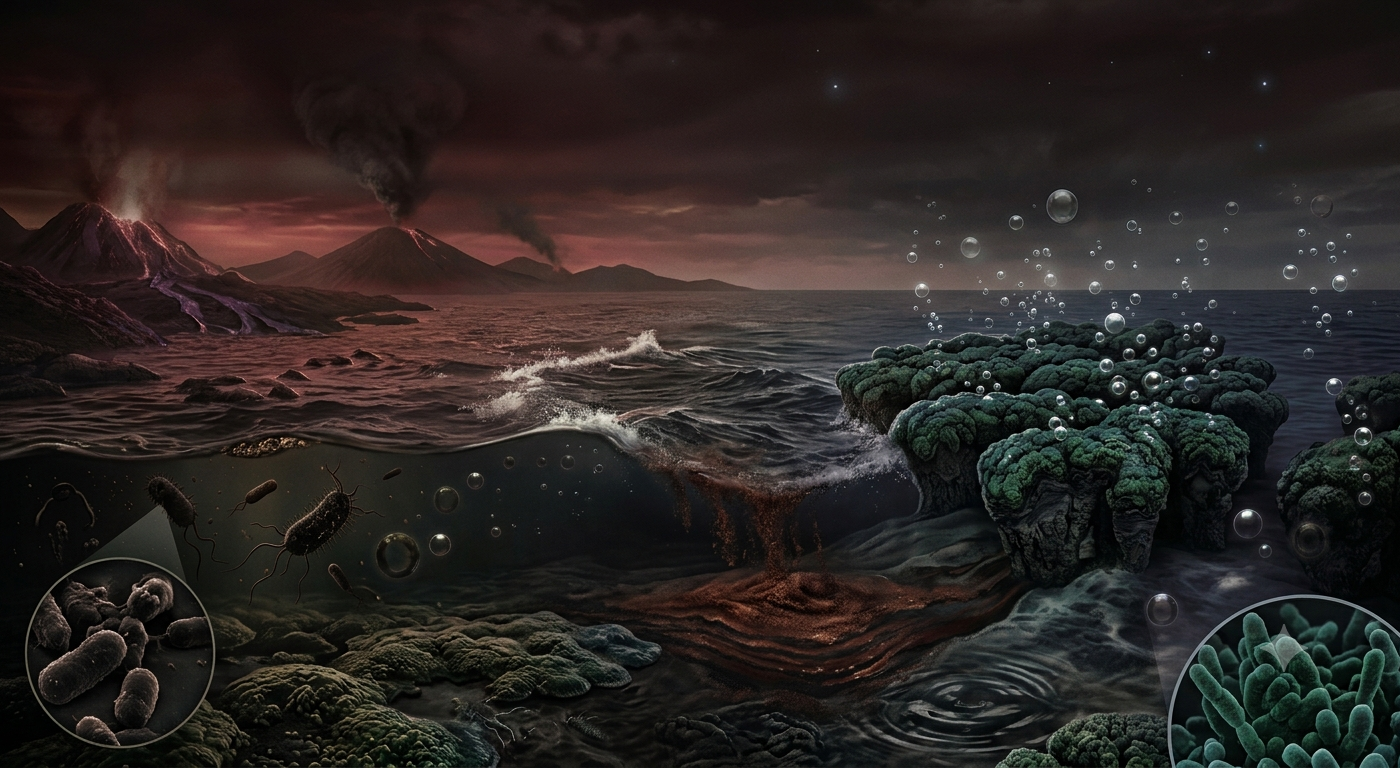
About 2.4 billion years ago, Earth’s atmosphere was radically different from today’s. It consisted of carbon dioxide (CO₂), methane, ammonia, and water vapor. There was no free oxygen at all. And it was in this environment that life—anaerobic organisms—first emerged and flourished.
But then a mutation occurred. Cyanobacteria (blue-green algae)—the ancestors of all modern plants—appeared. They developed photosynthesis and began absorbing carbon dioxide and releasing oxygen as a byproduct.
For the planet’s native inhabitants, oxygen was incredibly toxic. It destroyed their enzymes and burned their cells. In science , this event is officially known as the Great Oxidation Event. It was the first and most extensive mass extinction in Earth’s history. Cyanobacteria, like an uncontrollable virus, terraformed the planet to suit themselves, literally “burning out” with oxygen those for whom CO₂ was the natural environment.
Case Study No. 2: Oxidative Stress. The Price Paid for Survival
How did our ancestors survive? They had to form a symbiotic relationship by ingesting bacteria capable of converting toxic oxygen into energy (today we call them mitochondria). We learned to breathe this toxin. But we paid a terrible price for this adaptation—mortality.
This is where the science of aging comes into play. In 1956, gerontologist Denham Harman proposed the free-radical theory of aging, which is now one of the leading theories in biology.
Oxygen is the most powerful oxidizing agent (it is what causes metal to rust and apples to turn brown). During respiration, active forms of oxygen—free radicals—are produced in our cells. They constantly attack and damage our DNA, proteins, and lipids. This process is called oxidative stress.
It is oxygen that literally burns us from the inside out over the course of decades, leading to aging, wrinkles, disease, and, ultimately, death. If we lived in an environment consisting solely of stable CO2 and did not need oxygen, our cells could regenerate indefinitely without suffering this constant damage.
Dossier No. 3: Biological Memory of the Past
If you think we’ve definitively become “oxygen-breathing” creatures, take a look at how our bodies function right now. They still remember their carbon-dioxide past.
The Bohr Effect: In 1904, physiologist Christian Bohr discovered a remarkable law governing blood. Our hemoglobin does not deliver oxygen to the body’s cells unless there is a sufficient level of… carbon dioxide. In other words, without CO₂, we would suffocate even if there were an excess of oxygen. Carbon dioxide remains the key to our metabolism.
In utero hypoxia: In what environment does the human embryo develop? Under conditions of severe hypoxia (oxygen deprivation). The oxygen level in fetal tissues is several times lower than in an adult’s body. Nature literally shields the developing life from toxic oxygen until the fetus is ready for this “aggressive” environment.
Results of the Investigation
Modern humanity is descended from those who survived. When the “green virus” of plants filled the planet with toxic oxygen, our ancestors had a choice: perish or adapt.
We chose to adapt. We learned to use this dangerous oxidizer as high-octane fuel, becoming fast, warm-blooded, and active. But this trade-off proved to be fatal. The fuel that gives us life also set a countdown timer within our cells, robbing us of our potential for physiological immortality.
We breathe the poison we've grown accustomed to, and we call it air.
In my opinion, the best author is
It's a pretty good read.
quite intriguing and unexpected
O2 – Why are you doing this to us?)