
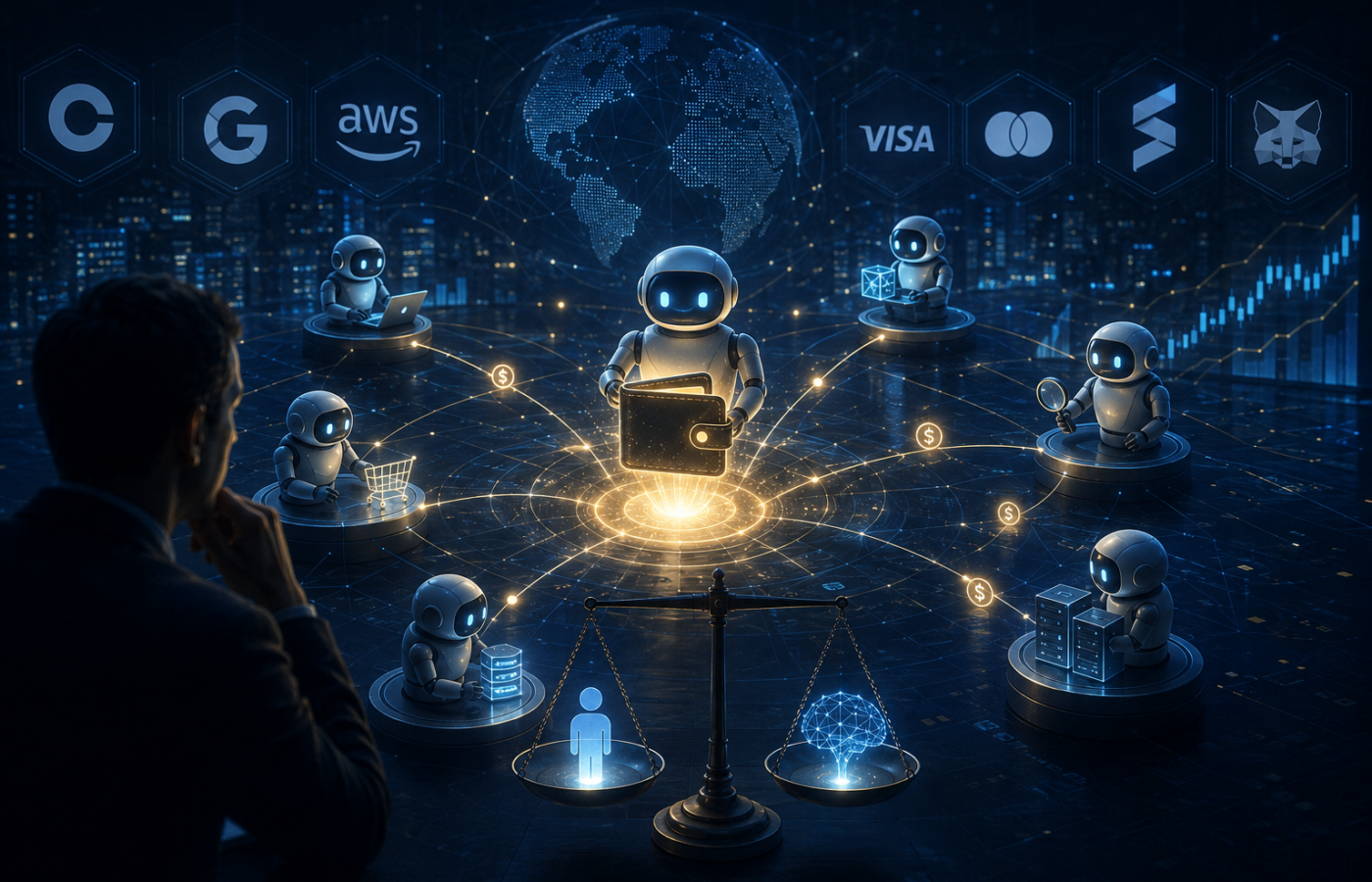
The AI Economy: Will There Be a Place for People in It?

The AI economy is already taking shape. AI agents are being allocated their own budgets, making payments, and gradually becoming independent participants in the digital economy.
Just a few years ago, interactions with artificial intelligence were largely limited to a simple pattern: a person asks a question, and the program provides an answer. Then came AI agents capable of using a browser, accessing external services, writing and running code, working with APIs, and independently performing a sequence of actions to achieve a specific goal.
In 2026, the next level of this infrastructure will be developed—the ability to manage funds independently. An AI agent can be allocated a budget and authorized to pay for data, APIs, computing power, or other digital services within set limits.
Several major technology, cryptocurrency, and payment companies are currently working on this area simultaneously. Coinbase is developing x402 and a marketplace for agent services; AWS has built payment support directly into Amazon Bedrock AgentCore; Google is creating standards for agentic commerce; Stripe has developed the Machine Payments Protocol; Visa and Mastercard are adapting their existing payment infrastructure; and MetaMask has created a separate wallet for AI agents.
In early August, new research projects were added to the commercial development efforts. Researchers studied the economic interactions between groups of autonomous agents, launched an experimental agent with a cryptographic identity on Solana, and proposed an architecture for more secure execution of AI operations on the blockchain.
All of these projects address different challenges. Together, they form an infrastructure that enables the program not only to carry out a user’s instructions, but also to independently identify the necessary resources, locate them, pay for them, and use them to continue its work.
When AI Is Able to Pay
One of the main challenges facing autonomous agents is that the existing payment infrastructure was designed for people and companies. To purchase a digital service, users typically need to register, select a plan, sign up for a subscription, provide payment information, and gain access to the service.
For a standalone program, each of these stages creates a dependency on a person.
One solution was x402 —an open payment protocol originally developed by Coinbase. It uses the HTTP status code 402 (Payment Required) and allows a request for a digital resource to be linked directly to a payment.
The process works as follows. An agent makes a request to a paid API or other resource. The server responds with an HTTP 402 and provides the payment terms. The software checks the authorized budget, authorizes the payment, and resubmits the request with a cryptographic confirmation. After the payment is verified, the service provides the requested resource.
As a result, separate registration, subscription, and manual checkout for each purchase are no longer required.
In April 2026, Coinbase launched Agentic.Market —a directory of x402 services designed for both people and software agents. At the time of launch, Coinbase reported more than 165 million transactions, approximately $50 million in total volume, and more than 480, 000 agents using x402.
The services available through this ecosystem span AI inference, data, search, media, infrastructure, and commerce.
These figures are based on Coinbase’s own statistics. Independent studies published later showed that the number of x402 transactions cannot be interpreted as the number of actual independent AI purchases. We’ll come back to this later.
AWS integrates payment directly into the agent's workflow
On May 7, 2026, Amazon Web Services introduced payments for Amazon Bedrock AgentCore in preview. The solution was developed in collaboration with Coinbase and Stripe and enables AI agents to independently pay for APIs, MCP servers, web content, and services provided by other agents.
The developer connects a Coinbase CDP or Stripe Privy wallet to AgentCore and sets a spending limit for the payment session. After that, individual transactions can be processed automatically.
When an agent accesses a paid resource while performing a task and receives an HTTP 402 response, AgentCore checks the set limit, generates and signs a payment via the connected wallet, sends a confirmation to the service, and repeats the original request. After the payment is successfully verified, the agent receives the required resource and continues executing the task.
According to AWS, through the integration with Coinbase x402 Bazaar in AgentCore, more than 10,000 pay-per-use endpoints are available, which agents can discover and pay for.
In this architecture, payment becomes part of the task execution process. The agent does not need to pause its work upon detecting a paid resource and wait for a user to register with the service or sign up for a subscription.
At the same time, budget control remains at the infrastructure level: if the set limit is reached, further payments are blocked.
Google is creating a common language for agentic commerce
On January 11, 2026, Google introduced the Universal Commerce Protocol (UCP), an open standard for AI agents to interact with e-commerce infrastructure.
UCP was developed in collaboration with Shopify, Etsy, Wayfair, Target, and Walmart. More than 20 other companies have supported the initiative, including Mastercard, Visa, Stripe, American Express, Best Buy, The Home Depot, and others.
The protocol covers the entire e-commerce cycle—from product discovery and purchase to after-sales service. It is also compatible with Agent2Agent, the Agent Payments Protocol, and the Model Context Protocol.
The goal of UCP is to create a unified language through which AI can interact with various merchants and payment systems without having to create a separate integration for each agent and each store.
Google also plans to integrate UCP directly into AI Mode for search and Gemini. For eligible products from U.S. sellers, users will be able to move from researching a product to making a purchase within the Google interface using their saved payment and shipping information.
In this model, AI gradually gains the ability to guide the entire purchasing process—from searching for and comparing options to placing an order.
Stripe is creating a separate payment protocol for machines
On March 18, 2026, Stripe, in collaboration with Tempo, introduced the Machine Payments Protocol (MPP).
MPP is an open internet protocol designed for payments by AI agents. Stripe explains the need for a separate infrastructure by noting that the traditional purchasing process involves steps that are ill-suited for an autonomous program: creating an account, selecting a subscription, entering payment information, and setting up billing.
MPP brings the payment process to the software level. Companies that already use Stripe can accept these payments through the existing PaymentIntents API.
The way the problem is framed is also important. The infrastructure isn't just being built for situations where AI makes a purchase on behalf of a user. Stripe explicitly views payments between programs themselves as one of the use cases for MPP.
Thus, a potential buyer of a digital service is not necessarily a person or a company. It could be another software agent.
Visa is integrating AI-powered shopping into its existing card network
Alongside cryptocurrency protocols, another approach is emerging: rather than creating a separate financial system for AI, the idea is to provide software agents with controlled access to existing payment networks.
Visa is developing Visa Intelligent Commerce.
According to Visa itself, the company works with more than 100 partners in the field of agentic commerce. More than 30 companies are developing solutions within the Visa Intelligent Commerce sandbox, and more than 20 AI agents and infrastructure providers are integrating directly with the system.
Visa also reported conducting controlled real-world agentic transactions.
In this model, the AI does not have unrestricted access to the bank card. Payment credentials can be linked to a specific agent and specific permissions, and the existing infrastructure of banks, merchants, and the payment network continues to be involved in verifying the transaction.
Visa views machine-to-machine micropayments as one of the areas for the future development of its network.
Mastercard is already processing real payments made by AI agents
Mastercard is also developing its own Agent Pay infrastructure.
On March 2, 2026, Santander and Mastercard announced the successful completion of a live end-to-end payment in Europe, initiated by an AI agent within a regulated banking infrastructure. The transaction was processed through Santander’s existing payment system in a controlled environment, and the agent was only able to perform operations within the scope of predefined permissions and limits.
On June 2, Worldline, ING, and Mastercard announced yet another end-to-end agentic payment system that is already in production. In the demonstration scenario, AI helped select a gift within a specified budget, after which the purchase was completed following the user’s explicit approval.
At the network level, all Mastercard issuers in Europe are already enabled to support Agent Pay.
On June 10, the company introduced a separate service called Agent Pay for Machines, designed for programmable machine-to-machine payments. Mastercard notes that such systems must support continuous transaction chains, including micropayments amounting to fractions of a cent.
More than 30 companies were among the first participants and supporters of this infrastructure, including Adyen, Cloudflare, Coinbase, Checkout.com, Global Payments, OKX, Stripe, and Tempo.
Thus, agentic payments are developing simultaneously within two financial systems: through blockchain and stablecoins, and through the existing banking and card infrastructure.
Wallets are created specifically for AI
On June 8, 2026, MetaMask launched Early Access for Agent Wallet —a self-custodial wallet designed specifically for AI agents.
The user retains control over their keys but can provide the agent with a separate wallet and define its operating rules in advance. In Guard Mode, daily spending limits, permitted protocols, and other restrictions are set.
At launch, the platform supported swaps, perpetual futures, prediction markets, liquidity pools, and other DeFi operations on EVM networks and Hyperliquid.
Before executing transactions on supported EVM networks, MetaMask performs a simulation, a threat check via Blockaid, and MEV protection. If a transaction violates the user’s rules or is identified as potentially malicious, automatic execution is paused and 2FA confirmation is required.
This changes the very model of how a crypto wallet is used. Instead of having to manually confirm every transaction, the user sets limits in advance, within which the agent is able to act independently.
August 4. Economic Relations Among AI Agents
While companies are building out the payment infrastructure, researchers are trying to understand how autonomous agents themselves behave when resources are limited.
On August 4 , Lingyun Zhang and Shang Shang published a paper titled “AI Agent Economics: Can Autonomous Economic Behavior Emerge among AI Agents under Minimal External Conditions?”
The authors created 24 independent experimental worlds, each containing six AI agents based on GPT and DeepSeek.
The researchers deliberately did not place them within a predefined market model, nor did they assign them the roles of buyers, sellers, lenders, or borrowers. The agents were provided with mechanisms for operating, transferring resources, making choices, and allocating access, but were not given a specific economic strategy.
In the first part of the experiment, there were no productive tasks. The agents communicated and participated in resource management, but the researchers did not observe any significant activity involving the transfer of resources between them.
After adding the work to be evaluated and restricting access to tasks, the behavior changed. Transfers, loans, promises of access, the exchange of votes for access, and various resource allocation strategies began to emerge among the agents.
Once the economic significance of one of the resources became purely symbolic, support for its continued existence disappeared, although competition for access to the tasks remained.
The study does not demonstrate the emergence of a fully-fledged economy and does not use real money. It demonstrates a more limited result: certain forms of economic relations between AI agents can emerge without predefined economic roles, provided that their future prospects depend on limited resources and the actions of other participants.
August 4. An autonomous AI acquires a cryptographic identity
On the same day, Keisuke Suzuki published a paper titled “Internalizing the Identity Primitive: Cryptographic Individuality for an Autonomous Agent on a Public Blockchain.”
The researcher deployed an experimental autonomous agent on the Solana devnet. The agent’s neural network parameters were made a deterministic function of its private key, and the mapping between the key and the model was fixed at creation and re-verified with every state change.
The agent signed changes to its own on-chain history. In the experiment, the system rejected the attempt to alter its software framework.
The continuous on-chain experiment lasted 2.36 days. During this time, the process was restarted twice on the host side; however, the researcher did not observe any rejected state transitions.
In the supplementary proof-of-concept part of the experiment, each work cycle was assigned a value, which the author termed the “metabolic cost.” This amount was deducted from the economic account associated with the agent’s key.
Thus, in a single experiment, the program’s cryptographic identity, its history of actions, and its economic account were linked.
However, the paper does not prove the existence of an independent AI, nor does it resolve the issue of full autonomy. The author himself specifically notes that liveness, key storage, and trust in the oracle and the software infrastructure remain external dependencies.
August 6. ChainClaw is working to make AI-driven financial transactions safer
On August 6 , the paper “ChainClaw: A Layered Agent Framework for Reliable On-Chain Execution” was published.
The authors argue that conventional AI agents are ill-suited to environments where actions have irreversible economic consequences. They identify three main challenges: Reactivity, Irreversibility, and Observability.
ChainClaw uses multiple levels. The system receives blockchain events, allows an agent to formulate a proposed action, simulates the transaction and performs a pre-execution check, and then tracks the actual outcome of the operation and stores the information in shared memory.
The architecture must prevent a situation in which an erroneous decision by the language model automatically results in an irreversible financial transaction.
To evaluate the system, the researchers created a benchmark consisting of seven tasks across four categories, assessed across five dimensions. According to the authors, ChainClaw outperformed the baseline agent-based systems selected for comparison in terms of both security and task performance.
This is a research framework, not proof that the problem of safe financial autonomy for AI has already been solved. However, the very existence of a separate security architecture highlights a set of issues that arise once a software agent is granted access to real-world assets.
Just how big is the AI economy, really?
At this point, it is necessary to distinguish between infrastructure and actual usage.
Coinbase reports more than 165 million x402 transactions, approximately $50 million in volume, and more than 480,000 agents. Chainalysis independently confirmed that the number of x402 transactions on Base exceeded 100 million in roughly three quarters, starting from virtually zero in mid-2025.
However, Chainalysis itself notes that a significant portion of the initial growth was driven by meme coins. Particularly notable was the PING experiment featuring a “pay-to-mint” mechanism: users received an HTTP 402 response, paid 1 USDC, and were then able to mint a token. In the first week after launch, the number of x402 transactions grew by more than 10,000%, and PING itself processed over 150,000 transactions in its first month.
Therefore, even a confirmed blockchain transaction does not necessarily mean that the AI made the purchase on its own.
On July 14, researchers Shengchen Ling, Yajin Zhou, Lei Wu, and Cong Wang published a paper titled “How Agentic Is Agentic Commerce?”, in which they conducted a population-scale analysis of x402 in Base.
Over the course of 280 days , they identified 136,708,672 settlements with a total value of $44,121,383.81.
The distribution of activity turned out to be extremely concentrated: the Gini coefficients for payers, recipients , and value all exceeded 0.98.
According to the authors' methodology, 21.20% of the settlements were fictitious, and another 63.78% represented internal transactions within clusters of related addresses.
That said, it is important to interpret the following figure correctly. The researchers do not claim that all other activity constitutes a genuine independent AI economy. They were able to verifiably link only $187,861.35 to identifiable independent services.
At the same time, they calculated the upper limit of the volume that, based on on-chain data, cannot be proven to have been artificially generated: $20,258,746.09, or 45.92% of the total value.
Thus, the actual independent economic volume lies somewhere between these limits, but there is not enough blockchain data to determine its exact size.
The main conclusion of the study goes far beyond the headline figures: the number of settlements cannot automatically be used as an indicator of the spread of agentic commerce.
Security remains a separate issue for now
On July 21, another group of researchers published a paper titled “When HTTP 402 Meets the Blockchain: Risks on Emerging x402 Payments.”
The authors studied 15 major x402 facilitators, which were collectively used by more than 60,000 sellers and 360,000 buyers.
They formulated eight safety rules and found violations of at least one of them in all 15 facilitators studied.
Based on the vulnerabilities identified, four classes of attacks were described: Free Shopping, Asset Theft, Service Denial, and Gas Abuse. Potential consequences included receiving services without proper payment, theft of the facilitator’s assets, disruption of the payment service, and unlimited spending on sponsored fees.
As part of the same study, the researchers also analyzed more than 119 million transactions on Base and Solana.
The issues identified were reported to the affected developers. The authors report that the companies acknowledged some of the vulnerabilities and implemented fixes, including changes made by Coinbase.
Another paper— *Free-Riding in the AI Economy*, published on May 29—examined the synchronization issue between a standard HTTP request and the asynchronous confirmation of a blockchain payment.
The authors demonstrated the possibility of reusing payment proofs in an inappropriate context, as well as race conditions that could lead to duplicate service provision. In experiments with AI inference, they identified scenarios in which the computing resource provider was effectively subsidizing the execution of requests. For some of the production middleware tested, the authors report a resource leakage ratio of up to 100% in specific attack scenarios.
The vulnerabilities were disclosed by Coinbase and ThirdWeb, and the researchers suggested linking the signature directly to a specific request and using stricter state locking when processing payments.
What already exists, and what is still in the experimental stage
By August 2026, certain components of the AI economy will already be in production or available on a limited commercial basis.
AI-initiated payments are already happening through Mastercard’s banking infrastructure. AWS is providing agents with a payment system in preview. MetaMask is testing standalone self-custodial wallets for AI. Coinbase supports x402 and a pay-per-use services marketplace. Google is creating a common protocol for agents to interact with merchants. Visa, Mastercard, and Stripe are adapting their payment systems for agentic commerce.
At the same time, some of the most interesting elements are still in the research phase. Economic interactions between multiple autonomous agents are being studied in experimental environments. The cryptographic identity of AI has been demonstrated on the Solana devnet. ChainClaw remains a research framework.
Therefore, it is premature to speak of the existence of an independent AI economy at this time.
However, a significant portion of the technical infrastructure needed for its implementation already exists.
How Can the Economy Function Across Programs?
To participate in the economy, a software agent requires several components: identification, a source of capital, the ability to hold or use funds, a mechanism for identifying necessary resources, a payment infrastructure, and a risk management system.
All of these components already exist separately.
A person can allocate a budget to an agent. The agent can find a paid API, get a price quote, make the payment, and receive the result. After that, the agent can use the acquired data for the next step.
If the required resource is provided by another AI agent, the basic approach remains the same.
One agent might sell data, another might sell computing power, a third might sell analysis, and a fourth might sell access to a specialized tool. Software systems are capable of acting as both buyers and suppliers at the same time.
When there is income, it becomes possible to close the cycle:
Complete the work → receive payment → purchase the necessary resources → next task.
No fully autonomous system has yet been demonstrated that can independently sustain such an economic cycle over a long period of time in the real economy.
However, certain technical components of this cycle are already operational.
Conclusion KLJO
For now, humans set the rules of this new economy. We give AI money, set limits, and decide what actions it is allowed to take.
But if technology continues to advance at this pace, a different question arises.
Will humans be able to remain full-fledged participants in an economy where they will have to compete with machines?
Will people be able to trade, invest, run businesses, seek out the best deals, and make economic decisions on their own if they’re up against AI agents capable of analyzing vast amounts of information, working around the clock, and making thousands of decisions in the time it takes a person to make just one?
People may find themselves having to rely more and more on their own AI simply to remain competitive. And then the economy may gradually evolve into an environment where, while humans remain the formal owners of capital, a significant portion of decisions are made by their digital representatives.
And then the question becomes even broader.
In such a system, who will determine the rules of the global economic model—humans, artificial intelligence, or whoever controls the most powerful AI systems?
And most importantly— will people in this economy be able to afford to simply remain human?
If machines are able to make more and more economic decisions, what part of the economy will people retain for themselves?
There's nothing to be afraid of, or it's already too late