From Seashells to Bitcoin: The Evolution of Money

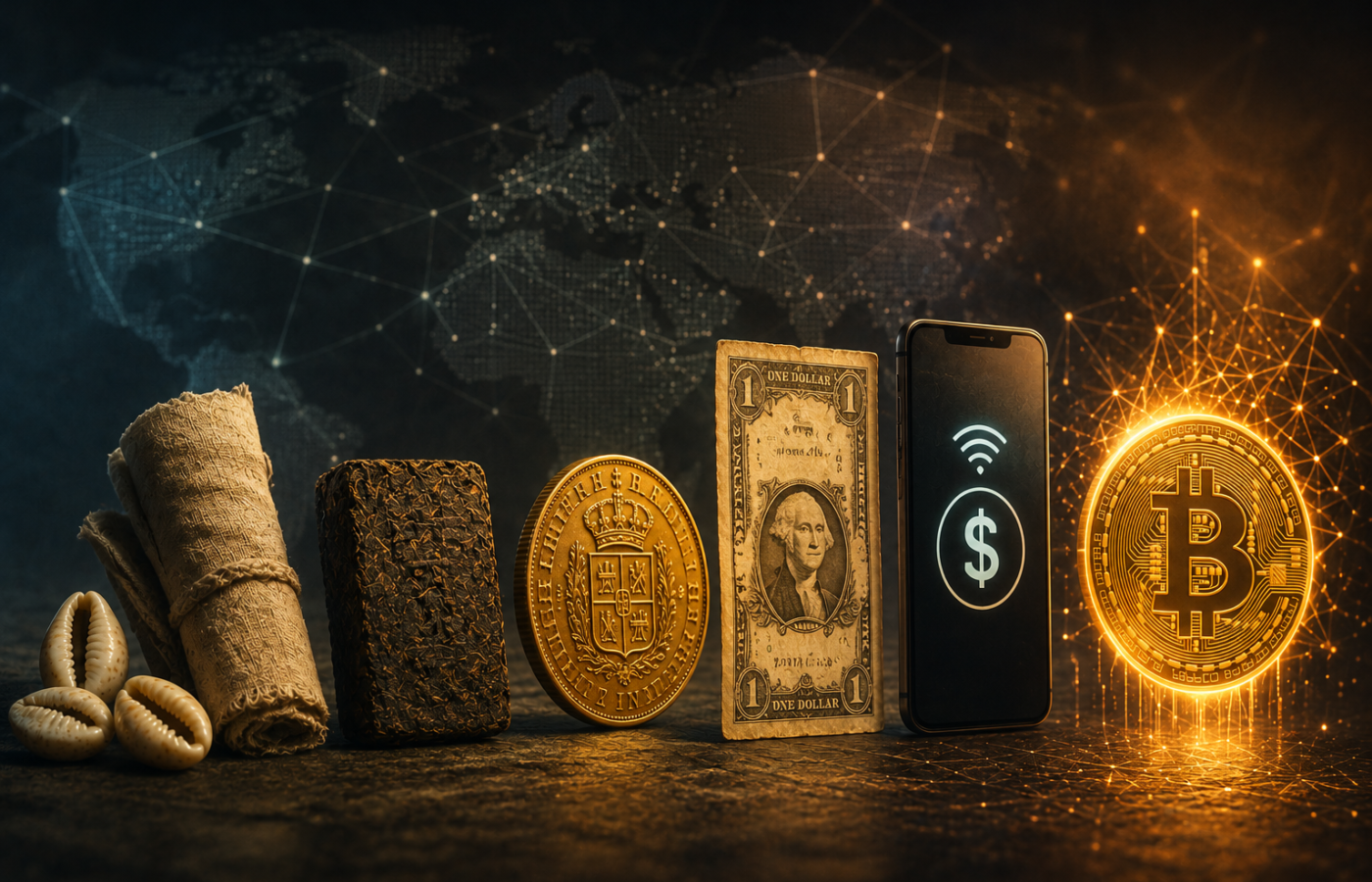
Today, this sounds almost absurd. But it was precisely with such items that the evolution of money began—an evolution that, thousands of years later, has led us to bank accounts, digital payments, and Bitcoin. Cowrie shells were used as a medium of exchange in various parts of Asia and Africa. They were small, durable, easy to transport, and difficult to counterfeit. People used them to buy goods, measure wealth, and collect and store them.
For a person of that era, a bag of seashells could have been a real fortune. Not because there was anything special inside the shells, but because other people agreed to regard them as valuable.
And perhaps it is precisely this characteristic of money that has remained virtually unchanged to this day.
From Seashells to Silk and Tea
As trade developed, perceptions of value also changed. In ancient China, silk became one such asset. For a long time, its production remained a complex and closely guarded process, and the material itself was lightweight, expensive, and in high demand far beyond China’s borders.
Silk was not just a commodity. At various times, it was used for transactions and payments. A portion of one’s wealth could literally be rolled up, loaded onto an animal, and transported halfway across the continent.
The history of tea is even more fascinating. It was pressed into dense bricks, which were easy to transport, store, and break into pieces. In Tibet, Mongolia, Siberia, and other regions of Central and Northern Asia, these bricks eventually became a fully-fledged form of currency. This practice continued all the way into the 20th century.
Tea was used to pay for goods, to pay workers, and to trade for livestock. In some regions, twenty tea bricks could buy a horse.
Today, the idea of paying with seashells, a roll of silk, or a brick of tea seems strange to us. But I think our money would have seemed even stranger to people back then.
Gold and the Age of the Dublon
As states and international trade developed, metals became increasingly important. Copper, silver, and especially gold had clear advantages. They are durable, can be divided, remelted, standardized by weight, and transported over long distances. And gold had another important quality: it was scarce.
For centuries, gold coins have been one of the main symbols of wealth.
Perhaps one of the most recognizable images of that era today is a pirate chest filled with gold doubloons. However, doubloons themselves were not a specific pirate currency. They were official Spanish gold coins that became widely circulated thanks to the vast trading network of the Spanish Empire.
A classic doubloon worth two escudos weighed about 6.77 grams and contained approximately 6.2 grams of pure gold. These coins were transported between continents, traded, hoarded, and, of course, often fell into the hands of pirates when merchant ships were captured.
For a person living in the 17th century, a chest full of gold was practically the ideal embodiment of wealth. Gold can be seen, touched, counted, and hidden. It doesn’t depend on a bank, a server, or electricity.
It would seem—what could be more reliable?
But even gold ceased to be the primary form of everyday currency.
Gold turned into paper, and paper turned into numbers
The reason is quite simple. It is inconvenient to transport large quantities of gold. It is much easier to store the metal in a safe place and use a document certifying its value instead.
Gradually, paper money began to replace metal money. Then the next transition took place, and money no longer necessarily represented the right to receive a certain amount of gold.
At some point, value became completely separated from the material. A hundred-dollar bill may be worth $100, even though the paper it's made of is worth practically nothing.
And these days, even paper is becoming less and less necessary.
Our paychecks are deposited into our bank accounts. We hold our phones up to a terminal, buy things online, and send money to the other side of the world. Yet no one physically hands any money over to anyone else. It’s simply a matter of entries being updated in computer systems.
A person can own millions and never actually see those millions right in front of them.
If you look at the evolution of money over the course of several thousand years, a rather surprising picture emerges. At first, seashells were used as currency. Then came silk or tea. Next came gold. Then paper. Today, it might simply be an entry on a server.
And in 2009, Bitcoin was introduced.
Bitcoin as the Money of Our Time
Bitcoin has offered the world the next step. It is a digital asset that does not require a single bank or government to maintain a central ledger in order to exist.
Limited supply, a decentralized network, cryptographic proof of ownership, and the ability to transfer value directly.
I consider Bitcoin to be one of the most important financial inventions of our time. Perhaps that is why another thought has always struck me as odd: why did we decide that Bitcoin is where the evolution of money should end?
History as a whole tells us the opposite.
Once upon a time, a person could spend their entire life collecting cowrie shells and consider them true wealth. In other places, wealth was measured in rolls of silk or stockpiles of tea. A Spanish merchant measured his fortune in gold coins. A few generations ago, paper bills were the most natural form of money. We now take it for granted that wealth is simply numbers in a banking app or Bitcoin in a cryptocurrency wallet.
To each generation, the money of its time seems natural.
And it seems to me that with Bitcoin, we could fall into exactly the same trap.
What Comes After Bitcoin
Technology continues to evolve. And one of the most interesting future challenges for modern cryptocurrencies is quantum computing.
Bitcoin is not protected by some kind of eternal mathematical armor. It is based on specific cryptographic algorithms. If sufficiently powerful quantum computers are developed in the future, some of the digital signature schemes used today could be compromised.
This does not mean that one day someone will turn on a quantum computer and Bitcoin will instantly disappear. More likely, if such a threat becomes a reality, Bitcoin will have to adapt. New cryptographic solutions, new security measures, and, possibly, significant changes to the protocol itself will be required.
But for me, something else is more important here.
To survive the next technological era, Bitcoin will have to change as well.
And that's perfectly normal.
Bitcoin will either evolve alongside technology, or another system will eventually take its place. Just as has happened with all previous forms of money.
And that in no way diminishes Bitcoin's value today.
On the contrary, its historical significance may prove to be far more important than any specific price. Bitcoin has proven that digital scarcity is possible; that value can be transferred around the world without a physical medium; and that a vast financial network can exist without a single central authority.
But the technology that changed the game doesn't necessarily have to be the latest one.
In fifty or a hundred years, a completely different way of storing and transferring value may emerge. It may be based on technologies that don't even exist today.
That's why I would never focus exclusively on Bitcoin as the ultimate form of money.
It could end up costing much more. It could become a global reserve asset. It could survive the quantum era and evolve alongside it. Or it could one day give way to the next technology.
Conclusion KLJO
Seashells, silk, tea, gold doubloons, paper money, bank accounts, Bitcoin.
The entire history of money shows how our understanding of what constitutes value has changed over the millennia. And each time, the money of that era seemed perfectly natural and reliable to people.
That’s why, for me, Bitcoin is first and foremost an asset of our era. Perhaps one of the most important ones. But I see no reason to believe that our generation, of all generations, has suddenly managed to discover the final form of money in human history.
A hundred years from now, people may look at a hardware wallet and a seed phrase written on paper much the same way we look at a string of cowrie shells or a gold doubloon today.
Not because Bitcoin turned out to be useless or wrong.
It's just that a new era has begun.
Every era has its own currency. And ours is unlikely to be the last.