
World ID: Sam Altman Is Bringing Cryptocurrency Under Biometric Control

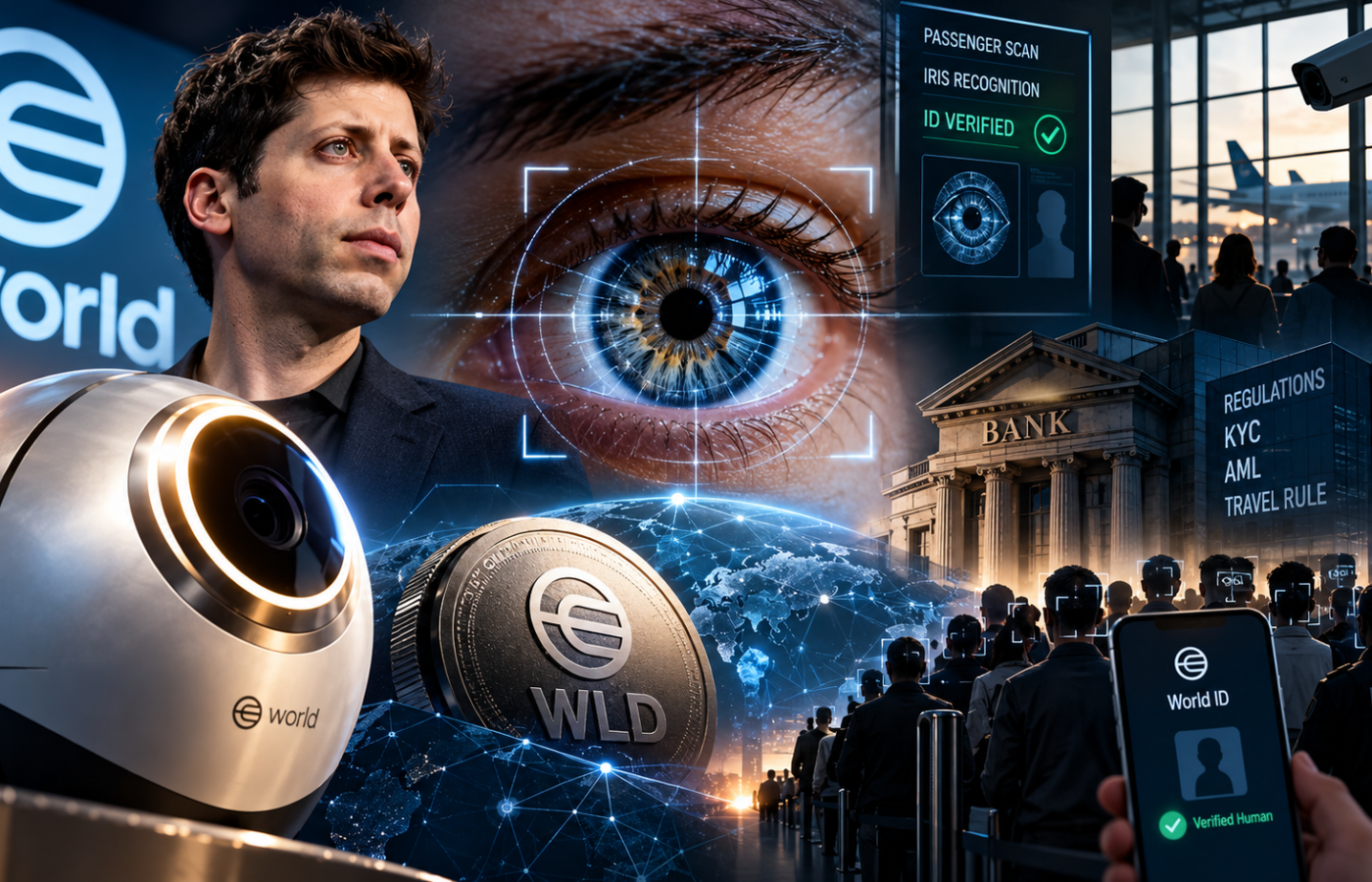
World ID is entering the banking sector. As regulators tighten their grip on cryptocurrencies, banks take custody of digital assets, and exchanges demand increasingly detailed personal information, Sam Altman’s project is proposing the next level of identification: iris scanning. While accessing your own money once required identification documents, biometric verification could eventually become another requirement. Cryptocurrency, originally created as an alternative to the banking system, is gradually turning into its digital extension.
Sam Altman Introduces a New Identification System for Banks
On October 18, 2026, World, a project co-founded by OpenAI CEO Sam Altman, introduced World ID for Banking and Finance.
The system is designed for banks, investment companies, and other financial institutions. Its purpose is to verify that a real person, rather than an AI system or a fraudster, is behind a financial transaction, request, or video call.
The technology is built around World ID’s biometric verification system. Users undergo verification through a device called the Orb, which scans their eyes and face before issuing cryptographic proof that they are unique human beings.
The new product combines three main components:
- World ID App: A tool for storing and presenting digital credentials.
- World ID for Zoom: A system for verifying the presence of a real person during video conferences.
- World ID for Agents: A mechanism for verifying the authority of AI agents acting on behalf of humans.
Organizations involved in developing the solutions include Bain Capital, VanEck Funds, Pantera Capital, OpenExchange, and Outtake.
According to World, more than 18 million people have already received proof of their unique humanity.
However, no bank has yet been publicly identified as having implemented the new system for its customers. This is a technology entering the financial market, not the introduction of mandatory biometric verification.
Cryptocurrency Was Supposed to Free Us From Banks. The Opposite Is Happening
Remember why Bitcoin was created.
In 2009, Satoshi Nakamoto introduced an electronic payment system that did not require trusting a financial intermediary. Individuals could control their own private keys and transfer funds directly without seeking permission from a bank.
But over the years, an enormous centralized infrastructure has developed around open blockchains.
Banks now offer cryptocurrency custody services. Exchanges require Know Your Customer (KYC) verification and proof of the source of funds. Europe’s Markets in Crypto-Assets Regulation (MiCA) establishes requirements for crypto-asset service providers, while the Travel Rule requires certain information about senders and recipients to accompany cryptocurrency transfers.
Issuers of certain stablecoins, including USDT and USDC, also have the technical ability to freeze tokens held at specific addresses.
And now another potential layer of control is emerging: biometric identification.
The evolution is rather ironic.
First, users were told cryptocurrency would allow them to operate without banks. Then banks began holding cryptocurrency on their behalf. Now the financial industry is being offered technology that could become an additional condition for accessing certain services.
The blockchain itself remains decentralized. But access to it through everyday financial services is becoming increasingly centralized.
This is where the original promise of financial independence begins to fade.
You Can Change Your Password. You Cannot Change Your Iris.
The most serious concern surrounding World ID involves biometric data.
During enrollment, the Orb captures images of a user’s eyes and face. Biometric information is then used to determine whether that person has already completed verification.
World’s developers claim that the original images are transferred to the user’s device and deleted from the Orb.
To verify uniqueness, the system uses Anonymized Multi-Party Computation (AMPC). A derived biometric code is converted into protected fragments distributed among independent participants.
World ID also uses Zero-Knowledge Proofs (ZKPs), allowing certain properties to be verified without disclosing the underlying information.
Technically, this architecture is considerably more sophisticated than a conventional centralized database of biometric images.
However, one detail deserves particular attention.
According to World’s documentation, distributed AMPC fragments cannot be deleted after their creation, although the company maintains that they are anonymized and do not reveal the original biometric information.
This introduces a problem that cannot be solved by simply changing a password.
If attackers steal your password, you can replace it. If usable biometric templates are compromised, you cannot replace your own iris.
This does not mean that a leak of World’s encrypted fragments would automatically allow someone to reconstruct images of users’ eyes. Such a capability has not been demonstrated.
Nevertheless, the consequences of a hypothetical compromise involving usable biometric identifiers could be permanent.
Airports, Police, Banks: What Happens If the Databases Are Connected?
Biometrics is no longer merely a technology for unlocking smartphones.
Airports and border authorities use various biometric verification systems. Law enforcement agencies work with facial images, fingerprints, and other identifiers. Banks maintain extensive records of their customers, accounts, and financial transactions.
Now, technology designed to verify a person’s uniqueness is entering the digital financial sector.
There is an important technical distinction, however.
Facial recognition and iris recognition operate differently. The fact that an airport stores biometric information does not mean its records can automatically be matched against World ID data.
Furthermore, World’s cryptographic architecture is specifically designed to prevent independent services from tracking the same person through their World ID credentials.
But privacy protections within a single protocol do not eliminate the possibility of connecting information through other identifiers.
If banks, digital platforms, and government systems eventually gain the technical and legal ability to link records belonging to the same individual, organizations could potentially construct a remarkably detailed picture of that person’s financial activities.
Which services they use, which transactions they conduct, which accounts they control, and which counterparties they interact with.
Controlling Bitcoin itself would not be necessary.
It would be enough to control the intermediaries through which people purchase, sell, store, and use digital assets.
The most effective way to control cryptocurrency is not necessarily to control the blockchain. It is to control access to it.
And the potential expansion of mandatory biometric verification could make that control even more extensive.
Regulators Have Already Restricted World’s Biometric Data Collection
Concerns about World are not purely theoretical.
The project’s activities have already attracted scrutiny from data protection authorities in several countries.
In Spain, regulators imposed restrictions on the project’s processing of biometric information.
In Brazil, the national data protection authority, ANPD, upheld a prohibition in 2025 on offering financial compensation to individuals in exchange for collecting their iris data.
The central concerns involved the lawful processing of sensitive personal information, informed consent, and whether consent can truly be considered voluntary when financial incentives are involved.
World subsequently modified its data storage architecture and continued developing additional privacy protections.
However, these regulatory disputes demonstrate that promises from developers are not enough.
Even a technically sophisticated privacy system must comply with legislation and offer users a genuine choice.
World ID, Artificial Intelligence, and Financial Transactions
World ID for Agents deserves particular attention.
Artificial intelligence systems are gradually gaining the ability to interact independently with digital services, access payment infrastructure, and carry out tasks on behalf of users.
World proposes a mechanism through which an AI agent can present cryptographic proof that it has been authorized by a verified human.
At first glance, the idea makes sense.
Financial institutions need to know who authorized an action performed by autonomous software.
But it also creates another potential point of dependency.
If major payment platforms eventually accept transactions from AI agents only when they present credentials issued through a particular identity provider, users could become dependent not only on their bank and AI developer but also on the identity verification system itself.
For now, AgentKit remains in beta, and there is no confirmed requirement from banks to make such verification mandatory.
Nevertheless, the technology illustrates the direction in which financial infrastructure is evolving: from verifying individual transactions to verifying the humans and software agents behind them.
What Does the WLD Token Have to Do With All This?
World operates not only a digital identity system but also a cryptocurrency ecosystem associated with the WLD token.
This creates additional interest in the financial implications of the project.
In July 2026, World Foundation raised $52.5 million through the sale of WLD tokens subject to a one-year lockup.
However, the banking product announcement does not establish any requirement for financial institutions to purchase WLD or use the token when verifying customers.
Therefore, presenting World ID for Banking and Finance as a guaranteed driver of demand for WLD would be misleading.
Something else matters far more.
A project originating in the cryptocurrency industry is attempting to turn its identity verification system into part of the global financial infrastructure.
The irony is that technologies associated with decentralization are now being used to build infrastructure that could potentially strengthen centralized control over access to financial services.
Decentralization Remains in the Code. Freedom Disappears From the Interface.
Today, World ID is not a mandatory requirement for accessing bank accounts or using cryptocurrencies.
There is no evidence that the project provides biometric records to police authorities, connects airport databases to cryptocurrency wallets, or operates a global surveillance system.
It would be misleading to present potential risks as established facts.
But ignoring the broader trend would be equally irresponsible.
Banks are expanding their influence over cryptocurrency markets. Regulators are strengthening requirements for intermediaries. Centralized exchanges increasingly resemble licensed financial institutions. Some stablecoins retain mechanisms allowing issuers to freeze assets.
Against this backdrop, technologies are emerging that can verify not only a person’s identity but also their physical uniqueness.
Each initiative can be justified individually in the name of security.
Together, however, they could produce a financial system in which individuals must disclose or verify increasingly extensive information about themselves simply to access their own assets.
The central question is no longer whether World ID can protect users from fraud. Such technology certainly has legitimate applications.
The question is something else entirely:
Will people retain the right to refuse biometric verification if banks and digital platforms eventually make it a condition of service?
Bitcoin was created so that individuals could control and transfer their money without needing permission from financial intermediaries.
Seventeen years later, we increasingly find ourselves discussing which documents must be submitted, which checks must be passed, and which restrictions must be accepted before someone can use cryptocurrency.
Now our eyes could potentially be added to that list.
We were promised financial freedom without banks. Instead, banks are coming back for our money, regulators are coming for our transactions, and new identity systems are coming for our biometrics.
And if this trend continues, the word “decentralization” risks becoming little more than an attractive label attached to technology whose everyday access is controlled by entirely centralized institutions.
Sources
- World — World ID for Banking and Finance, October 18, 2026
- The Block — World Launches World ID Suite for Banks, October 18, 2026
- World — World Privacy FAQs
- World — What Happens to Your Data After Orb Verification
- World — Introducing AMPC: Privacy and Performance in World ID
- European Banking Authority — Travel Rule Guidelines for Crypto-Asset Transfers
- ANPD — Brazilian Data Protection Authority Decision on Iris Data Collection