
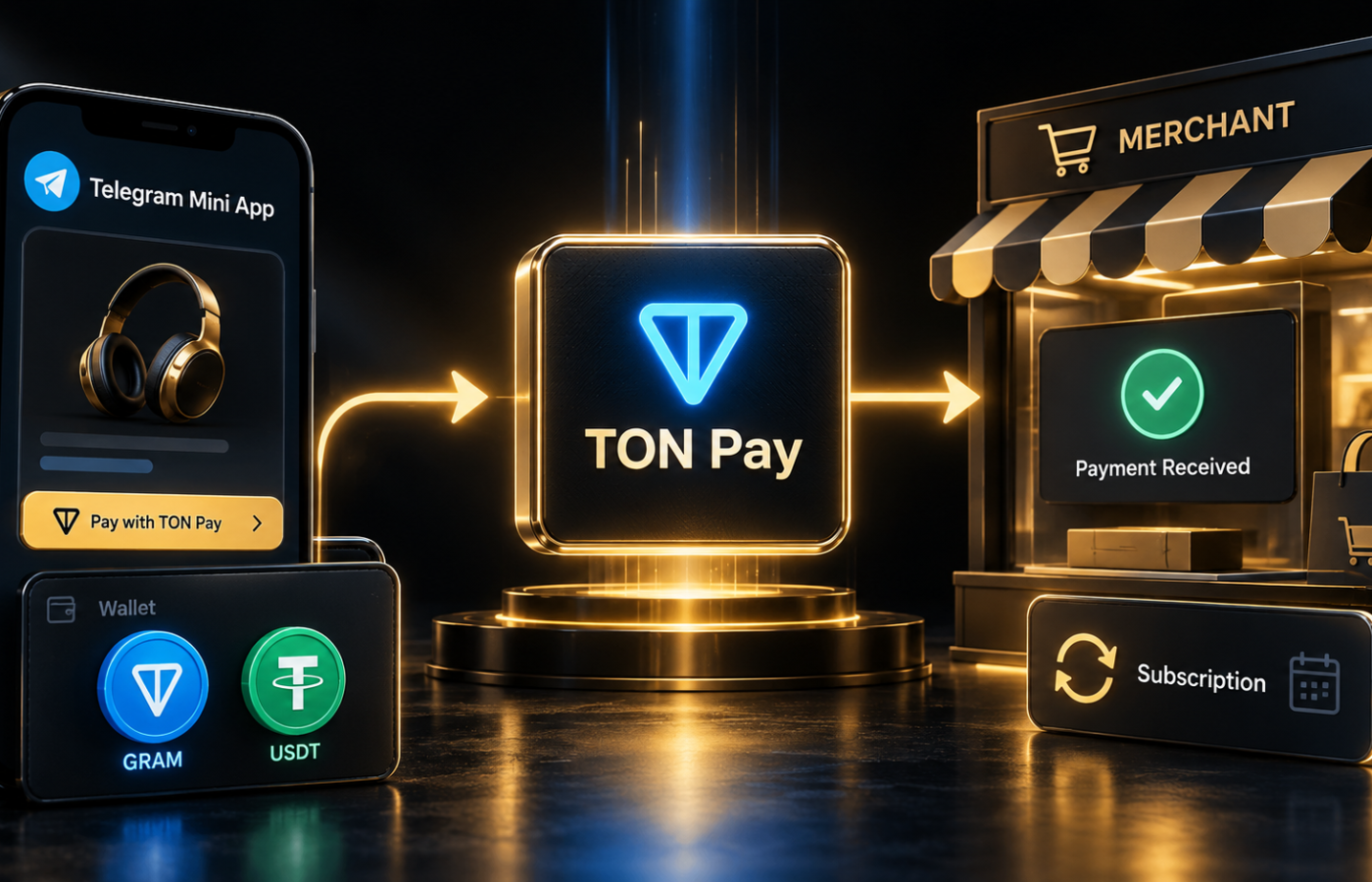
Telegram Is Building Its Own Blockchain Stripe — TON Pay

A new payment layer has appeared in the TON ecosystem — TON Pay. Its goal is to give Telegram Mini Apps, bots, and other applications ready-made infrastructure for accepting blockchain payments without forcing developers to build checkout systems, transaction tracking, and payment logic from scratch.
TON Pay is still in Beta, and new integrations are currently limited. But the more important point is the direction: TON is gradually assembling a complete business infrastructure inside Telegram — from wallets and user connections to payments and, eventually, recurring subscriptions.
What TON Pay Actually Does
TON Pay works through TON Connect. An application creates a payment request, sends it to the user’s wallet, and after confirmation the transaction is submitted to the TON blockchain. The application can then track its status and link the payment to a specific order.
TON Pay itself does not need to hold user or merchant funds. Money moves directly between wallets, while TON Pay handles the payment layer around the transaction: checkout, payment IDs, status tracking, and confirmation that the correct amount has actually been received.
For developers, this removes a significant part of the infrastructure work. There is no need to build a separate payment-tracking system or run a TON indexer simply to determine whether an order has been paid.
The Real Product Is the Checkout
Sending tokens from one TON wallet to another is already possible without TON Pay. The value of the new layer is not the transfer itself, but turning a blockchain transaction into a normal payment flow for an application.
An order gets an identifier, the application can verify its status, the user gets a familiar payment interface, and the developer receives a standard way to connect an on-chain transaction with a specific purchase.
This matters especially for Telegram Mini Apps. In normal commerce, seeing an incoming transaction in a wallet is not enough. A business needs to know what the payment was for, which order it belongs to, whether the full amount was received, and when access to the product or service can be granted.
TON Pay is designed to handle exactly this layer.
The Next Step Is Subscriptions
TON materials also mention recurring payments and subscriptions. If this functionality reaches mass adoption, TON Pay becomes much more important than a simple payment button.
Telegram Mini Apps could use it for recurring premium access, AI services, information bots, SaaS plans, gaming subscriptions, and other ongoing payments.
That would move the Telegram economy beyond one-time crypto purchases. It would create a framework for continuous payment relationships between users and applications directly inside Telegram.
This is where the comparison with Stripe becomes especially relevant. Not because TON Pay copies traditional card processing, but because it is trying to make payments a standard application feature rather than a separate blockchain project inside every Mini App.
USDT Could Be the Key
Another important part of the picture is stablecoins. TON infrastructure supports Jettons, including USD₮, and this is far more practical for real businesses than accepting only a volatile native asset.
For ordinary users, paying a fixed $10 equivalent for a service is much easier to understand than paying in a token whose value could change significantly within days.
If TON Pay becomes a convenient standard for USDT payments inside Mini Apps, Telegram effectively gets a blockchain checkout denominated in digital dollars. A user chooses a product, confirms the transaction in a wallet, and remains inside the same ecosystem throughout the process.
For TON, this could matter much more than another temporary increase in DeFi TVL.
TON Is Assembling the Entire Payment Stack
TON Pay is not appearing in isolation.
Gram Wallet is becoming Telegram’s native blockchain wallet. TON Connect links applications with user wallets. WalletKit helps developers build wallet functionality. AppKit simplifies the creation of TON-based applications. TON Pay now adds the payment layer.
The result is an increasingly complete chain:
Telegram → Mini App → Wallet → TON Pay → TON blockchain.
Developers need less and less custom blockchain infrastructure of their own.
This suggests that TON is moving beyond being simply a blockchain accessible through Telegram. It is becoming an infrastructure environment where a developer can build an application, connect a user, access a wallet, and add payments without assembling every component independently.
Why This Matters More Than Another DeFi Protocol
Crypto networks are often judged by TVL, token activity, or DEX volume. But for mass adoption, another metric matters more: how many real economic actions users can perform without even thinking about which blockchain is underneath the application.
If TON Pay begins processing purchases, subscriptions, gaming payments, AI services, digital goods, and micropayments, the value of TON will no longer depend only on speculative activity around its native token.
The network would begin processing the everyday economic activity of applications inside Telegram.
That could create a much more persistent flow of transactions than another temporary memecoin cycle or short-lived DeFi boom.
TON Pay Is Not Yet a Full Blockchain Stripe
The current state of the product should not be overstated.
TON Pay remains in Beta. Public documentation indicates that new integrations are temporarily unavailable, while some of the broader functionality, including recurring payments, still needs to prove itself at scale.
So today, TON Pay is better described as an attempt to build a Stripe-like payment layer for blockchain applications inside Telegram, rather than a finished equivalent of Stripe.
But the direction is already clear. TON wants developers to think less about transactions, RPC infrastructure, indexers, and wallet mechanics — and more about simply adding payments to their products.
KLYO’s Take
Gram Wallet solves one part of the problem: giving users direct access to blockchain money inside Telegram. TON Pay is designed to solve the next one — making that money usable across applications.
If TON can reduce checkout, transaction confirmation, USDT payments, and subscriptions to a simple unified SDK, then TON’s most important product may no longer be the blockchain itself.
It could become a ready-made economy inside Telegram, where wallets, applications, and payments all exist in the same environment.
And that is much closer to what a blockchain version of Stripe would actually look like.
Sources
TON Dev News — Introducing TON Pay