
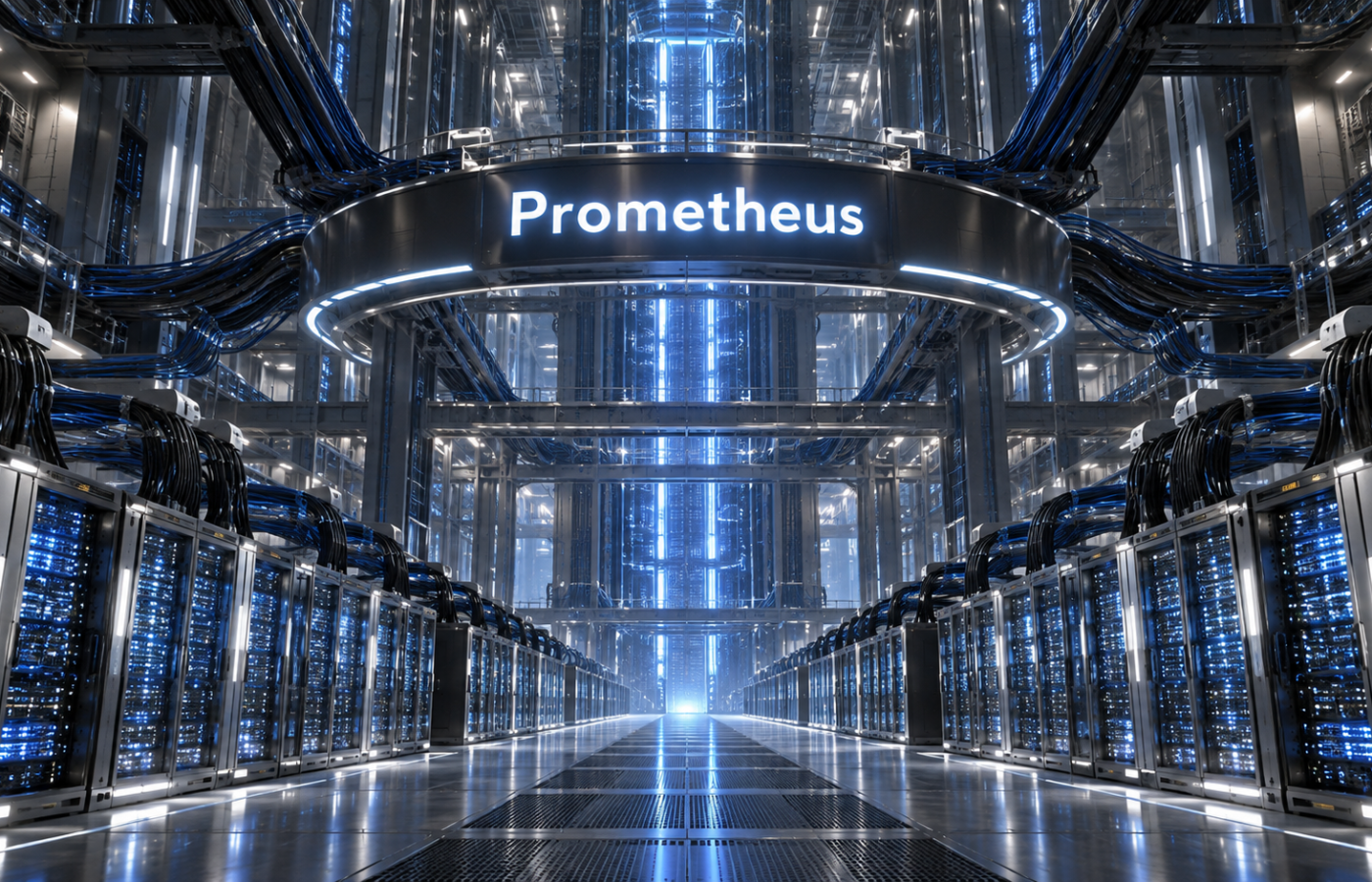
Prometheus: One Million GPUs. Meta Is Building a Computing Monster

Meta has revealed technical details of Prometheus, one of the world’s largest computing facilities designed for artificial intelligence. The system already connects hundreds of thousands of NVIDIA graphics processors, with the ultimate goal of integrating approximately one million GPUs into a unified computing infrastructure. The facility is being developed in New Albany, Ohio, with its power infrastructure designed for gigawatt-scale workloads.
What We Know About Prometheus
On October 19, 2026, Meta published a detailed engineering report covering the construction and operation of Prometheus.
The first phase of the facility is already operational and is being used to train artificial intelligence models, including the Muse family.
Key project specifications:
- Up to 1 million GPUs in the planned final configuration.
- Hundreds of thousands of GPUs are already deployed across the infrastructure.
- Up to 20,736 GPUs can be connected within a single building through a dedicated networking system.
- Distances between individual computing facilities exceed 100 kilometers.
- The infrastructure includes tens of thousands of network switches and millions of miles of fiber-optic strands.
- The power infrastructure is designed to support gigawatt-scale workloads.
What Hardware Powers Prometheus?
Meta uses Catalina and Clemente server platforms built around NVIDIA GB200 and GB300 accelerators.
Each NVL72 configuration connects 72 GPUs through NVIDIA’s high-speed NVLink interconnect.
NVIDIA GB200 NVL72:
- 72 Blackwell GPUs.
- 13.4 TB of total GPU memory.
- Up to 1.44 EFLOPS of FP4 computing performance.
- NVLink bandwidth of up to 130 TB/s.
NVIDIA GB300 NVL72:
- 72 Blackwell Ultra GPUs.
- 20.7 TB of total GPU memory.
- NVLink bandwidth of up to 130 TB/s.
- Power consumption of approximately 135 kW per rack.
Meta uses a dedicated Backend Ethernet network to connect servers and enable high-speed data exchange during distributed AI training.
Nearly 1,000 Failures per Day
During its early operational phase, Prometheus encountered significant reliability challenges.
In mid-2025, Meta recorded nearly 1,000 computing interruptions per day for every 8,000 GPUs.
The main causes included:
- GPU hardware failures.
- GPU memory errors.
- NVLink connection failures.
- Networking and cooling problems.
- Software-related interruptions.
To improve reliability, Meta introduced hardware redundancy. In certain groups of 72 GPUs, 64 accelerators handle the primary computing workload while the remaining eight serve as reserves.
The company also developed Parallelism-Aware Fault Tolerance, a technology designed to recover individual computing processes without restarting an entire training job.
Over the following year, Meta reduced interruptions by 99% compared with peak levels.
During Muse Wonder training, useful computing resource utilization exceeded 85%, reaching more than 90% in certain reinforcement learning workloads.
Power Consumption and Cooling
One of the major engineering challenges for Prometheus is managing sudden fluctuations in electrical demand.
When large computing workloads start or stop, power consumption can change by 30–40%. In absolute terms, these fluctuations can amount to tens of megawatts within seconds.
To manage these loads, Meta developed Dynamo Dimmer, a system that dynamically adjusts GPU power limits.
The facility also uses:
- Liquid cooling for computing racks.
- Battery energy storage systems.
- Capacitors to smooth short-term power spikes.
- Automated power management infrastructure.
Next Generation: NVIDIA Vera Rubin
Meta plans to expand its computing infrastructure using NVIDIA’s next-generation Vera Rubin accelerators.
The upcoming San Miguel platform is expected to feature 72 GPUs equipped with HBM4 memory.
The announced specifications include:
- 288 GB of HBM4 memory per GPU.
- Memory bandwidth of up to 19.2 TB/s per GPU.
- Up to 2.52 EFLOPS of FP4 computing performance per rack.
- Power consumption exceeding 170 kW per rack.
- Fully liquid-cooled architecture.
According to Meta’s estimates, the new architecture should deliver a 10–20% improvement in performance per watt compared with GB300 NVL72.
In addition to Prometheus, Meta is developing another major AI computing facility, Hyperion, in Louisiana.
Prometheus is already being used to train AI models, but the planned configuration of one million GPUs has not yet been reached. Meta has not specified an exact completion date for the full deployment of its computing infrastructure in the published engineering report.
Sources
- Meta Engineering — Inside Prometheus: Meta’s Journey to a Gigawatt-Scale Supercluster
- Meta — Official Prometheus Supercluster Video