Europe Is Squeezing the Life Out of Stablecoins

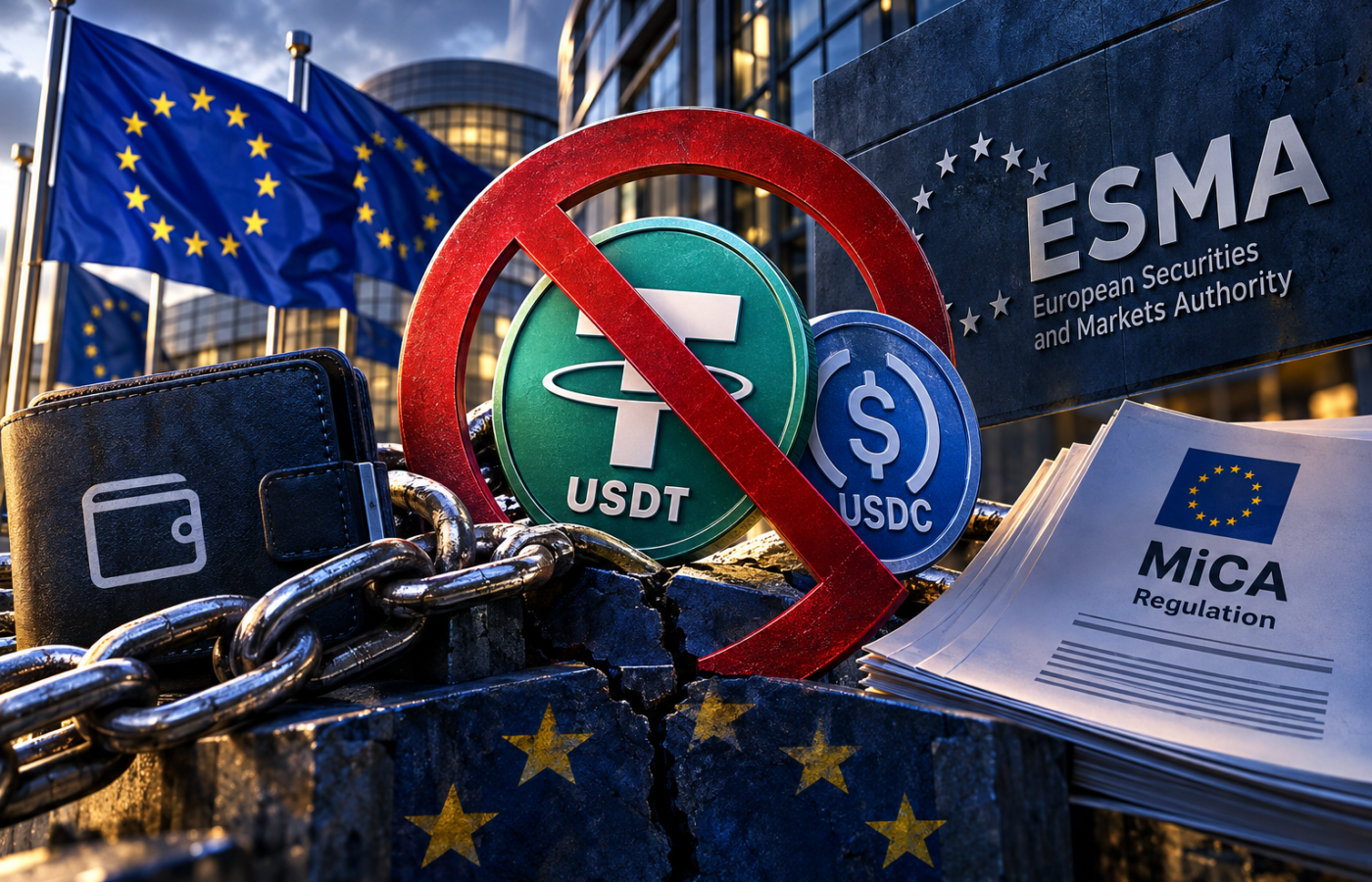
Europe is squeezing the life out of stablecoins. The European Securities and Markets Authority (ESMA) is tightening its grip on the cryptocurrency market. Simply removing a non-compliant stablecoin from an exchange is no longer enough. Restrictions now extend to transfers, asset custody, portfolio management, and other crypto services. Even custodial wallets fall within the scope of these requirements. Market participants have been given up to three months to resolve remaining compliance issues.
Europe Expands Stablecoin Restrictions
The European Securities and Markets Authority (ESMA) has published document ESMA75-113276571-1742, addressing cryptocurrency services involving stablecoins that do not comply with the Markets in Crypto-Assets Regulation (MiCA).
This continues a regulatory policy that led to several stablecoins being removed from trading pairs on European cryptocurrency exchanges in 2025.
But the regulator is now going further.
While the initial focus was primarily on trading and token distribution, the latest clarification covers a much broader range of cryptocurrency services.
ESMA expects licensed Crypto-Asset Service Providers (CASPs) to stop providing EU clients with services involving stablecoins that do not meet European regulatory requirements.
Exchanges Are No Longer the Only Target
According to ESMA’s position, the restrictions affect:
- Operation of trading platforms and cryptocurrency exchanges.
- Reception, transmission, and execution of client orders.
- Crypto-asset transfers on behalf of clients.
- Custody and administration of crypto-assets.
- Cryptocurrency portfolio management.
- Investment advice and placement of crypto-assets.
These requirements apply regardless of whether the services are offered separately or combined within a single application.
And this is where things get particularly interesting.
A cryptocurrency company may remove USDT from its trading pairs while continuing to hold it in customer accounts, process transfers, or maintain existing balances.
ESMA now expects companies to address these remaining forms of access when the underlying stablecoin does not comply with MiCA.
Even Crypto Wallets Are Affected
The document does not introduce a blanket ban on cryptocurrency wallet software.
A personal non-custodial wallet, where users control their own private keys, does not become illegal simply because it holds USDT.
However, the situation changes when custody, private key management, or transfers are provided by a regulated cryptocurrency company.
For example, if a licensed service offers customers a custodial wallet, holds their stablecoins, and allows transfers to other users, those activities fall within the scope of MiCA.
In other words, embedding a wallet inside an application does not allow a company to continue providing services involving non-compliant stablecoins simply because exchange trading has been disabled.
At the same time, an application that merely provides an interface for users to manage their own private keys is not equivalent to a custodial service.
The legal treatment depends on the actual services being provided.
What Happens to USDT?
The biggest question concerns Tether’s USDT, one of the world’s most widely used dollar-pegged stablecoins.
In early 2025, ESMA and the European Commission called for services involving non-MiCA-compliant stablecoins to be brought into line with European legislation.
Major cryptocurrency exchanges subsequently began restricting access to certain tokens for users in the European Economic Area.
Binance, for example, removed USDT, DAI, and several other stablecoins from spot trading for affected users starting March 31, 2025.
However, some services continued to offer custody and certain other operations involving these assets.
ESMA’s latest clarification is intended, in part, to address this remaining regulatory gap.
Importantly, the document does not declare all dollar-backed stablecoins illegal.
The decisive factor is whether a particular token complies with MiCA requirements, not the currency to which its value is pegged.
Three Months to Resolve Compliance Issues
ESMA has established a clear supervisory timeline for national regulators.
If cryptocurrency companies still provide services or maintain client positions that do not comply with MiCA, they are expected to resolve the situation as quickly as possible, and no later than three months after the document’s publication.
This places the final reference date at January 8, 2027.
During the transitional period, ESMA allows a limited range of activities necessary to:
- Close existing positions.
- Convert assets.
- Withdraw funds.
- Complete transfers required to settle outstanding balances.
- Temporarily safeguard assets while positions are being resolved.
This is not permission to continue normal business operations.
Such activities must remain temporary, controlled, and justified by the need to wind down existing client relationships or positions.
How Will the Restrictions Work Technically?
ESMA does not prescribe a single software-based blocking mechanism.
Instead, companies are expected to implement the necessary technical, contractual, and organizational restrictions.
In practice, this could lead to several changes.
First: Purchase restrictions. Platforms may prevent customers from opening new positions in stablecoins that do not comply with MiCA.
Second: Deposit restrictions. A cryptocurrency service may disable deposits of a particular token, even though the token continues to function normally on its underlying blockchain.
Third: Wallet functionality restrictions. A custodial wallet may continue allowing withdrawals of existing balances while disabling ordinary transfers and other services involving the asset.
Fourth: Access controls. Companies may need to assess where their clients are located and whether their services provide access to non-compliant stablecoins.
These are potential methods of implementing the requirements, not a mandatory list of technical restrictions published by ESMA.
And this highlights a fundamental difference between a blockchain and a centralized cryptocurrency service.
Regulators can restrict a company’s activities, but those restrictions do not automatically stop a blockchain or destroy tokens held at personal addresses.
Who Benefits From the New Restrictions?
Tighter requirements could reshape competition in the European cryptocurrency market.
Stablecoins whose issuers comply with MiCA gain an advantage when integrating with licensed exchanges, payment services, and custodial platforms.
This creates more favorable conditions for regulated products from Circle, including USDC and EURC.
For users, however, the range of available assets may become narrower.
Instead of freely choosing between different dollar-backed tokens on the same platform, access increasingly depends on each asset’s regulatory status.
Developers of payment applications, trading platforms, and financial tools may also face additional costs related to token verification, access management, and regulatory compliance.
What Does This Mean for Ordinary Crypto Holders?
If USDT is held at a personal blockchain address controlled through a non-custodial wallet, ESMA’s document does not itself require the owner to transfer, sell, or destroy those tokens.
However, if the same USDT is held on the balance of a licensed European platform, the services available to that customer could change significantly.
In other words, the same token may remain fully functional on the blockchain while no longer being supported by a particular regulated service.
This is why cryptocurrency holders need to distinguish between three separate things:
- Ownership of a token.
- The technical ability to transfer it.
- Access to services provided by a regulated company.
These represent three different levels of control.
KLJOMPUS: Regulators Are Taking Control of the Infrastructure
Europe is not banning blockchains or declaring all cryptocurrency wallets illegal.
But the direction of regulation is becoming increasingly clear.
First came restrictions on stablecoin issuance and admission to trading. Then exchanges began removing non-compliant tokens from trading pairs.
Now regulators expect licensed companies to stop providing access to these assets through other services as well.
As a result, practically the entire centralized infrastructure through which users interact with cryptocurrencies is coming under regulatory scrutiny.
And this raises a fundamental question.
If a cryptocurrency continues to exist on a decentralized network, but regulated companies can no longer freely facilitate transactions involving it, how accessible does that cryptocurrency remain in practice?
Europe’s new regulatory reality appears to be less about banning the token itself and more about controlling every doorway through which users can access it.
Sources
- ESMA. Supervisory Expectations for Services Related to Unauthorized Stablecoins
- ESMA. Official Opinion ESMA75-113276571-1742
- ESMA and European Commission. Guidance on Non-MiCA-Compliant ARTs and EMTs
- European Systemic Risk Board. Crypto-assets and Decentralised Finance