
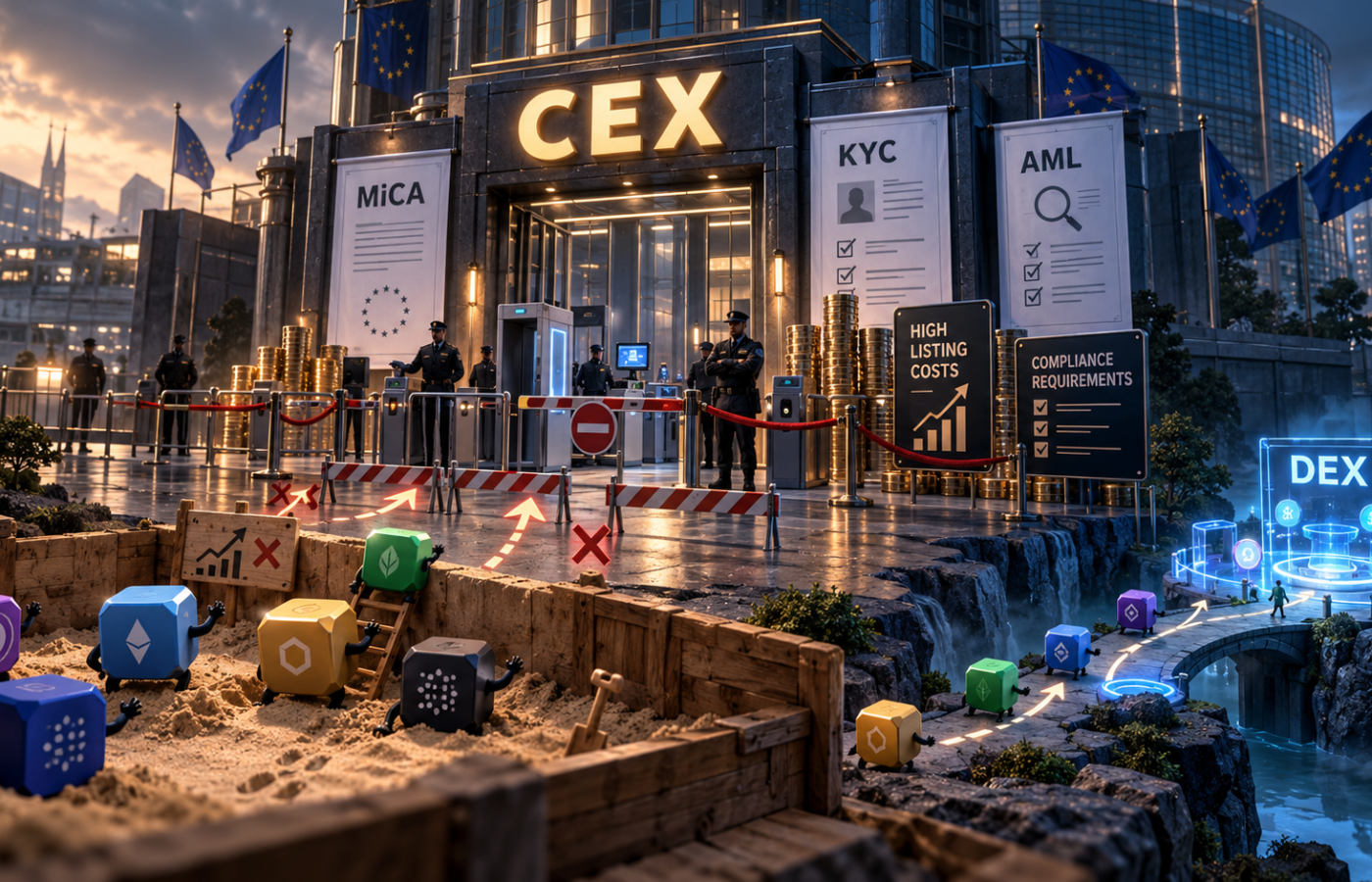
CEX Listing: Why Crypto Projects Are Trapped in Their Own Sandboxes

For many crypto projects, a CEX listing has gradually turned from an achievable goal into an almost impossible dream. While developers continue promising their communities listings on Binance, OKX, and other major exchanges, more and more projects are building closed internal economies where users can purchase virtual goods and upgrades with real money, but can only spend their earned tokens within the application itself.
This trend is particularly noticeable in Telegram, although the same model exists far beyond its ecosystem. Users are encouraged to purchase gaming resources using dollars, Telegram Stars, and other payment methods, upgrade virtual businesses, accumulate tokens, and patiently wait for the day when their digital wealth finally acquires real market value.
I don’t think the growing popularity of these closed economies is a coincidence. Within their own systems, developers control token issuance, pricing, and circulation. But once a token enters the open market, an entirely different set of responsibilities, expenses, and risks emerges. Most importantly, someone must explain who will actually buy all those accumulated tokens with real money, and why.
So let’s examine what a proper exchange listing costs today and why regulatory requirements are increasingly turning it into an unrealistic ambition for many smaller projects.
How Much Does a CEX Listing Cost in 2026?
Centralized exchanges are commonly divided into three categories: Tier 1, Tier 2, and Tier 3, based on their size, liquidity, and reputation. There is no universally accepted official classification, but it provides a useful framework for estimating listing budgets.
According to commercial market estimates, the approximate costs in 2026 look like this:
| Exchange Tier | Estimated Listing Costs | Total Launch Budget |
|---|---|---|
| Tier 3, smaller CEXs | $15,000–$30,000 | $50,000–$120,000 |
| Tier 2, mid-sized CEXs | $50,000–$250,000 | $100,000–$300,000+ |
| Tier 1, leading CEXs | Negotiated individually, sometimes free | $500,000–$1 million+ |
These figures are industry estimates, not official exchange price lists. Coinbase, for example, publicly states that it does not charge token listing fees. Major exchanges may consider projects without mandatory listing payments, but that does not eliminate the cost of preparation.
A serious listing budget includes legal support, smart contract audits, market-making services, marketing, and, most importantly, liquidity.
Imagine a token finally appears on a centralized exchange. Everything looks impressive, trading begins, and the developers celebrate their success.
Then a few holders attempt to sell $10,000 worth of tokens, and the price collapses by tens of percent.
Because an exchange is not obligated to buy tokens from everyone who wants to sell.
An exchange provides access to trading, but it does not guarantee the existence of buyers.
Decentralized exchanges offer a completely different financial proposition, but we’ll return to that shortly.
And while funding problems can theoretically be solved, regulatory requirements introduce an entirely different level of complexity.
MiCA: Europe No Longer Wants to Play the Anonymity Game
The European Union’s Markets in Crypto-Assets Regulation, commonly known as MiCA, has significantly changed the rules of the cryptocurrency market.
Its main provisions began applying on December 30, 2024. On July 1, 2026, the maximum EU-wide transitional period for crypto-asset service providers operating under previous national regimes came to an end.
Today, admitting an ordinary crypto-asset to trading on a regulated European platform generally requires a legal entity acting as the applicant, a MiCA-compliant crypto-asset white paper, the applicable notification to the competent authority, and public disclosure of information. Certain assets and circumstances are subject to exemptions.
However, I find Article 76 of MiCA particularly interesting.
It requires trading platform operators to assess crypto-assets before admitting them to trading, examining technical reliability, potential links to unlawful activities, and the reputation of issuers and development teams.
Article 76(1)(a) also requires procedures for assessing applicants, taking into account money laundering and terrorist financing risks.
And this is where things get particularly interesting.
How exactly is a project supposed to secure a listing when its developers hide behind pseudonyms, its token distribution is unclear, and neither its major wallets nor its actual beneficial owners are disclosed?
Within a small crypto community, this kind of anonymity may seem perfectly normal.
For a regulated exchange, however, it becomes a potential compliance problem that cannot be solved with another impressive promise on a roadmap.
KYC, AML, and Sanctions: When Anonymity Becomes a Liability
The next obstacle involves Know Your Customer (KYC) and Anti-Money Laundering (AML) requirements.
European cryptocurrency exchanges must carry out customer identification and anti-money laundering checks as required by applicable legislation. Additionally, EU Regulation 2023/1113, commonly associated with the Travel Rule, establishes information requirements concerning the originators and beneficiaries of crypto-asset transfers.
However, MiCA does not automatically require every user of a Telegram game or another application to undergo identity verification simply because its token is seeking an exchange listing.
Verifying exchange customers and conducting due diligence on the project itself are separate procedures.
Nevertheless, if developers cannot establish their ownership structure, sources of funding, or the origins of major token holdings, passing a serious exchange’s compliance review becomes considerably more difficult.
Now add sanctions to the equation.
In recent years, European restrictions on cryptocurrency-related transactions involving certain countries, organizations, and individuals have tightened significantly.
In particular, EU sanctions adopted during 2025 and 2026 expanded restrictions affecting Russian crypto companies, financial intermediaries, and infrastructure that European authorities associate with sanctions circumvention.
This does not mean that every citizen or user from a particular country is automatically prohibited from participating in cryptocurrency markets. Specific restrictions depend on sanctions designations, jurisdiction, residency, and the nature of the transactions involved.
But for exchanges, sanctions exposure creates another layer of compliance work.
Imagine an international crypto project with a substantial audience in sanctions-sensitive jurisdictions, an anonymous development team, and undisclosed ownership of its largest wallets.
The geographical distribution of users does not automatically prevent a listing. However, a lack of transparency makes risk assessments substantially more difficult, particularly when major token allocations, beneficiaries, or counterparties could potentially involve sanctioned persons.
An exchange needs to understand who it is entering into an agreement with, who controls the asset, and whether supporting that asset could violate applicable sanctions requirements.
Some major platforms also impose internal restrictions that go beyond the minimum legal requirements.
A popular token is no longer enough to secure a serious CEX listing. A project must also demonstrate legal and financial transparency.
And the more its economy has relied on anonymous accounts, unidentified wallets, and opaque token distribution, the harder that task becomes.
DEX: A Cheap Way Into the Market or Another Listing Illusion?
Against the background of substantial listing costs, MiCA requirements, KYC and AML procedures, and sanctions restrictions, decentralized exchanges may seem like an almost perfect solution for smaller crypto projects.
Unlike centralized exchanges, platforms such as Uniswap, Raydium, and PancakeSwap allow users to create trading pools without going through the traditional listing approval process.
And the most interesting part, of course, is the cost.
For example, creating a standard CPMM pool on Raydium costs just 0.15 SOL, excluding additional technical expenses and the liquidity required to fund the pool.
On Uniswap, creating a trading pool generally requires paying blockchain transaction fees and depositing assets into the pool. There is no mandatory commercial listing fee amounting to tens of thousands of dollars.
The difference is enormous.
Nor does creating a standard permissionless pool require the same project-level review typically conducted by regulated centralized exchanges.
Of course, this does not automatically exempt a public token offering or related activities from applicable laws, including MiCA.
That is precisely why DEX platforms are so attractive to smaller projects. A team can issue a token, create a trading pair, provide a modest amount of liquidity, and proudly announce that its long-awaited listing has finally happened.
Technically, that announcement may be perfectly accurate. The token is now available on an open market, where users can buy and sell it.
But there is one rather unpleasant detail.
Creating a trading pair can cost next to nothing. Building a genuinely liquid market requires an entirely different amount of money.
If a liquidity pool contains only a few hundred dollars’ worth of assets, even a relatively small sale can cause the token’s price to collapse.
And when thousands of users decide to exchange tokens accumulated over months or years for actual money, the results could be considerably more dramatic.
That is why I suspect that, for a significant number of smaller crypto projects, a DEX will not become the first step toward Binance or OKX.
It will become the final destination.
Not because decentralized exchanges are inherently bad, but because the ability to create a trading pair does not mean that a token has acquired genuine economic value.
You can establish trading on a DEX for next to nothing. But you cannot buy genuine market demand for the same price.
Why Exchange Listings Increasingly Remain Nothing More Than Promises
At this point, I think it becomes easier to understand why so many crypto projects continue operating entirely within their own internal economies.
The problem is not simply the cost of listing a token.
A project needs financing, liquidity, a legal structure, transparent tokenomics, and the ability to pass an exchange’s due diligence procedures.
And even meeting all these conditions does not guarantee approval.
Meanwhile, a closed economy offers developers some obvious advantages.
Users purchase virtual goods and upgrades with real money, while the resources they earn continue circulating inside the platform. Developers control the rules governing their use and, in the case of ordinary gaming items, are not required to create an external trading market.
There is absolutely nothing wrong with this model when a game sells entertainment without promising users investment returns.
But when developers spend years talking about future open-market trading, a reasonable question emerges: is the project actually prepared for it?
Once trading begins, accumulated tokens become real market supply.
And if thousands of users decide to exchange their holdings for money at the same time, who will provide sufficient demand?
This is precisely the question I believe many developers prefer to avoid.
It is much easier to keep introducing new internal mechanics, selling additional upgrades, and promising an exchange listing in the next roadmap update.
When will users be able to withdraw their accumulated tokens? After the listing.
When will the token acquire a real market price? After the listing.
And when exactly is the listing?
Stay tuned for updates.
I don’t doubt that some teams genuinely intend to reach major exchanges one day.
But I also suspect that, for certain projects, the promise of a future listing has become a convenient tool for retaining users and keeping them engaged.
And as financial and regulatory barriers continue to rise, the credibility of those promises becomes increasingly difficult to assess without concrete evidence.
Final Thoughts
I have nothing against smaller crypto projects, gaming economies, or Telegram applications. Quite the opposite. Some of them create genuinely interesting products and can operate perfectly well without exchange listings.
But I believe we need to distinguish between selling virtual entertainment and creating a genuine financial asset.
In the first case, users pay for a game and receive entertainment in return.
In the second, developers must be prepared for the demands of an open market, legal responsibilities, compliance checks, and adequate liquidity.
MiCA, KYC, AML, sanctions restrictions, and the overall cost of a proper listing have significantly increased the barriers to entering regulated centralized exchanges.
That is why I believe many smaller crypto projects will remain within their own ecosystems.
For some, a trading pair on a DEX may be the greatest milestone they ever reach, while a listing on a major centralized exchange remains an attractive line on the roadmap.
And perhaps this explains why we increasingly encounter projects where virtual goods can be freely purchased with real money, while earned tokens can only be spent inside the application.
Because building an internal economy and collecting money from users is far easier than creating a genuine open market where those same users can sell their assets.
And the next time a development team promises an imminent Binance listing, I would suggest asking one simple question.
Have you actually calculated how much it costs and what it takes to get there?
Perhaps that is where the most interesting conversation will begin.
Sources
European Regulation and Sanctions
- MiCA — EU Regulation 2023/1114
- ESMA — Article 76 of MiCA, Operating a Crypto-Asset Trading Platform
- EU Regulation 2023/1113 — Travel Rule
- European Commission — 19th Package of Sanctions Against Russia
- EU Regulation 2026/506 — Additional Sanctions Restrictions
Exchange Listing Costs
- Motion Trade — CEX Listing Costs in 2026
- Coinbase — Official Asset Listing Policy
- Raydium — Protocol Fees
- Uniswap — Creating a Trading Pool