
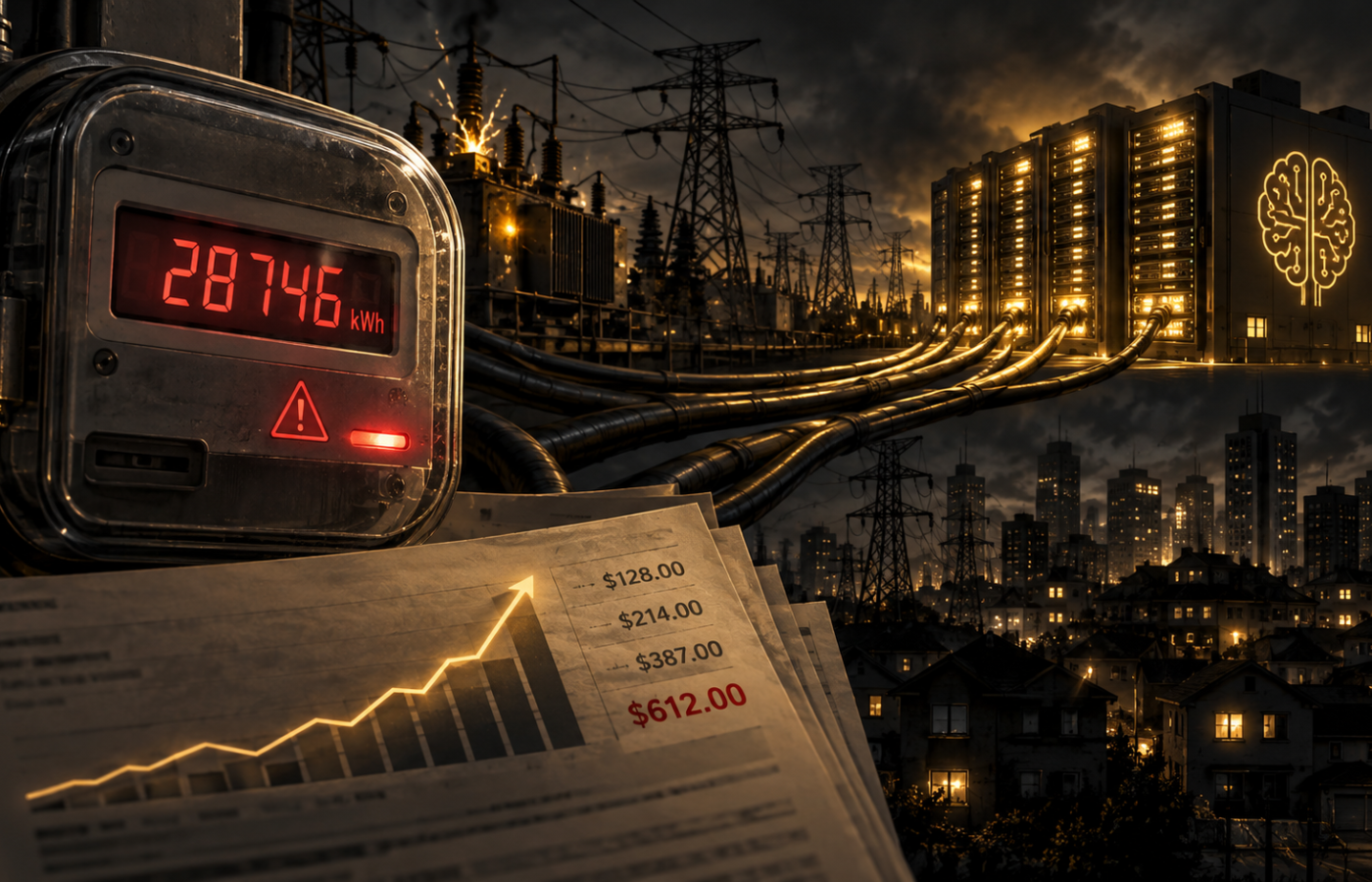
AI Energy Consumption: The OpenAI vs Anthropic Race Is Becoming an Energy Race

AI energy consumption is becoming a new problem for OpenAI, Anthropic, and the entire artificial intelligence industry. Data centers no longer need megawatts, but gigawatts of power, electricity prices are rising, and power grids are struggling to keep up with the pace of AI infrastructure expansion. The race for the most powerful model is gradually turning into a much more physical competition: who can secure enough affordable energy to keep all of this hardware running.
On September 16, Anthropic signed its first major data center agreement in Australia. The planned campus near Brisbane could reach up to 2.16 GW of capacity, with the first facilities expected to come online in 2027.
But the most important part is not the size of the project.
The infrastructure is intended primarily for inference, meaning the actual operation of Claude after training: processing user requests, performing tasks, analyzing documents, writing code, and running AI systems.
In other words, power on the scale of multiple large power-generation units is no longer needed only to train the next generation of AI. It is increasingly required just to keep existing models running.
And that changes the scale of the entire race.
AI Energy Consumption Is Changing the Rules
Until recently, most discussions about AI electricity demand focused on model training.
The logic was straightforward. A new Claude, GPT, or Gemini model is trained on massive clusters of accelerators running almost continuously for weeks or months. Once training is complete, the most energy-intensive phase appears to be over.
AI agents are beginning to break that model.
A normal chatbot interaction may involve a few user prompts. An agent can independently analyze information, call tools, execute code, verify results, fix mistakes, and return to the model again and again. What once required a single answer can turn into dozens or hundreds of separate computational steps.
Multiply that by millions of users, enterprise systems, and future fleets of autonomous agents, and the result is no longer temporary training demand. It becomes permanent industrial-scale electricity consumption.
Anthropic itself has described the scale of future demand in unusually direct terms. The company says training a single frontier model could soon require power measured in gigawatts, while the US AI sector may need at least 50 GW of additional capacity in the coming years. Anthropic has also pledged to cover grid-upgrade costs connected to its US data centers and compensate for potential increases in consumer electricity prices caused by that additional demand.
This is no longer ordinary software economics.
OpenAI No Longer Needs Just Servers. It Needs Power Systems
OpenAI is moving in the same direction.
When Stargate was announced, the company set a target of securing 10 GW of AI infrastructure in the United States by 2029. Just over a year later, OpenAI said it had already exceeded that target in contracted capacity. More than 3 GW had been added in only the previous 90 days.
OpenAI explains the situation very simply: demand for AI is growing so quickly that compute infrastructure has to be built even faster.
That means selecting a new site is no longer just about available land or space for server racks. Power availability, transmission lines, permits, labor, and the ability of a region to supply large amounts of electricity are becoming critical factors.
This is where the real paradox of the current AI race appears.
Algorithms can improve in months. A stronger model can be trained relatively quickly. Even accelerator production can eventually be scaled.
But a power plant cannot be downloaded from GitHub.
A transmission line cannot be built with a software update. Several gigawatts of generation cannot appear overnight. Substations, transformers, and grid connections have to be designed, approved, manufactured, and physically built.
The software industry is used to scaling almost instantly.
Now it has to scale at the speed of the energy sector.
Electricity Is Getting More Expensive at the Same Time
There is another problem.
It is not enough to simply find several gigawatts of power. Companies still have to pay for them.
According to the International Energy Agency, average wholesale electricity prices increased across several major regions in 2025, including Europe and the United States.
The situation remains particularly difficult for energy-intensive industries in the European Union. Electricity prices there were still more than twice as high as in the United States and around 50% higher than in China.
Average wholesale electricity prices in the EU reached roughly $95 per MWh, up about 10% over the year. Electricity generation also remains heavily influenced by gas prices, grid conditions, and geopolitical events.
For a traditional software company, electricity may remain just one line among many operating expenses.
For a company planning tens of gigawatts of AI infrastructure, it becomes one of the central elements of the business model.
The larger the model, the more compute it requires. The more popular the AI service becomes, the more inference it generates. The more agents are used, the longer the accelerators remain active.
AI companies are therefore facing an uncomfortable equation: they need more electricity precisely at the moment when cheap and readily available power is becoming a strategic resource.
Data Centers Are Starting to Change the Energy Market Itself
The problem becomes even more serious when AI infrastructure reaches a scale large enough to affect the market around it.
The US Energy Information Administration expects electricity consumption in the United States to set new records in 2026 and 2027. Data centers and the expansion of artificial intelligence are specifically listed among the major drivers of that growth.
Consumption is expected to rise from 4,195 billion kWh in 2025 to 4,270 billion kWh in 2026 and 4,349 billion kWh in 2027.
That means AI companies are no longer competing only with one another for electricity.
The same power is also needed by factories, cities, electric vehicles, railways, ordinary businesses, and millions of households. A giant new data center may require new transmission lines, substations, and generation capacity, and someone ultimately has to pay for that infrastructure.
At that point, the issue stops being purely technological.
When a major AI company enters a region and demands one or two gigawatts of power, it becomes an energy-system event.
The Next Stage of the OpenAI vs Anthropic Race
A few days ago, KLOMPUS examined how OpenAI and Anthropic are scaling not only the models themselves but also the number of AI agents that can operate simultaneously. The emerging advantage is increasingly about the ability to throw more compute at a problem than a competitor.
Now the other side of that strategy is becoming visible.
Compute cannot be scaled indefinitely simply by buying more GPUs. Every accelerator requires a rack. Every rack requires a data center. Every data center requires a substation. And somewhere beyond that, there has to be enough power generation to feed the entire system.
This is why the next stage of the AI race may look far less glamorous than model launches and benchmark charts.
Instead of parameters, scores, and demonstrations, the important numbers may increasingly be megawatts, gigawatts, electricity prices, and grid-connection timelines.
That shift is already happening.
Anthropic’s Australian project is designed for up to 2.16 GW. Nvidia is also planning to add up to 2 GW of AI capacity in Australia by 2027, more than the country’s current total data center capacity. OpenAI is already discussing infrastructure in tens of gigawatts.
AI is no longer just software.
It is becoming heavy industry.
KLO’s Take
We are used to looking for the limits of artificial intelligence inside the model itself: insufficient data, weak architecture, limited context, reasoning errors, or not enough compute.
But the next real limit may be much more basic.
The power socket.
You can build a more capable model and launch a million agents, but all of it still has to connect to a real energy system. Electricity cannot be generated by pressing Enter, power plants take years to build, grids have physical limits, and energy prices directly affect the cost of every new computation.
So the next stage of the race between OpenAI, Anthropic, Google, and everyone else may no longer be decided only by who has the smartest model.
The more important question may be much simpler:
Who will have enough electricity to turn it on?
Sources
KLOMPUS — OpenAI and Anthropic
Anthropic — Covering electricity price increases from our data centers
OpenAI — Building the compute infrastructure for the Intelligence Age
IEA — Electricity 2026: Prices
Reuters — US power use to beat record highs in 2026 and 2027 as AI use surges
Reuters — Nvidia plans major expansion of data centre capacity in Australia