
Elon Musk and NVIDIA: Can He Bring Jensen Huang Back?

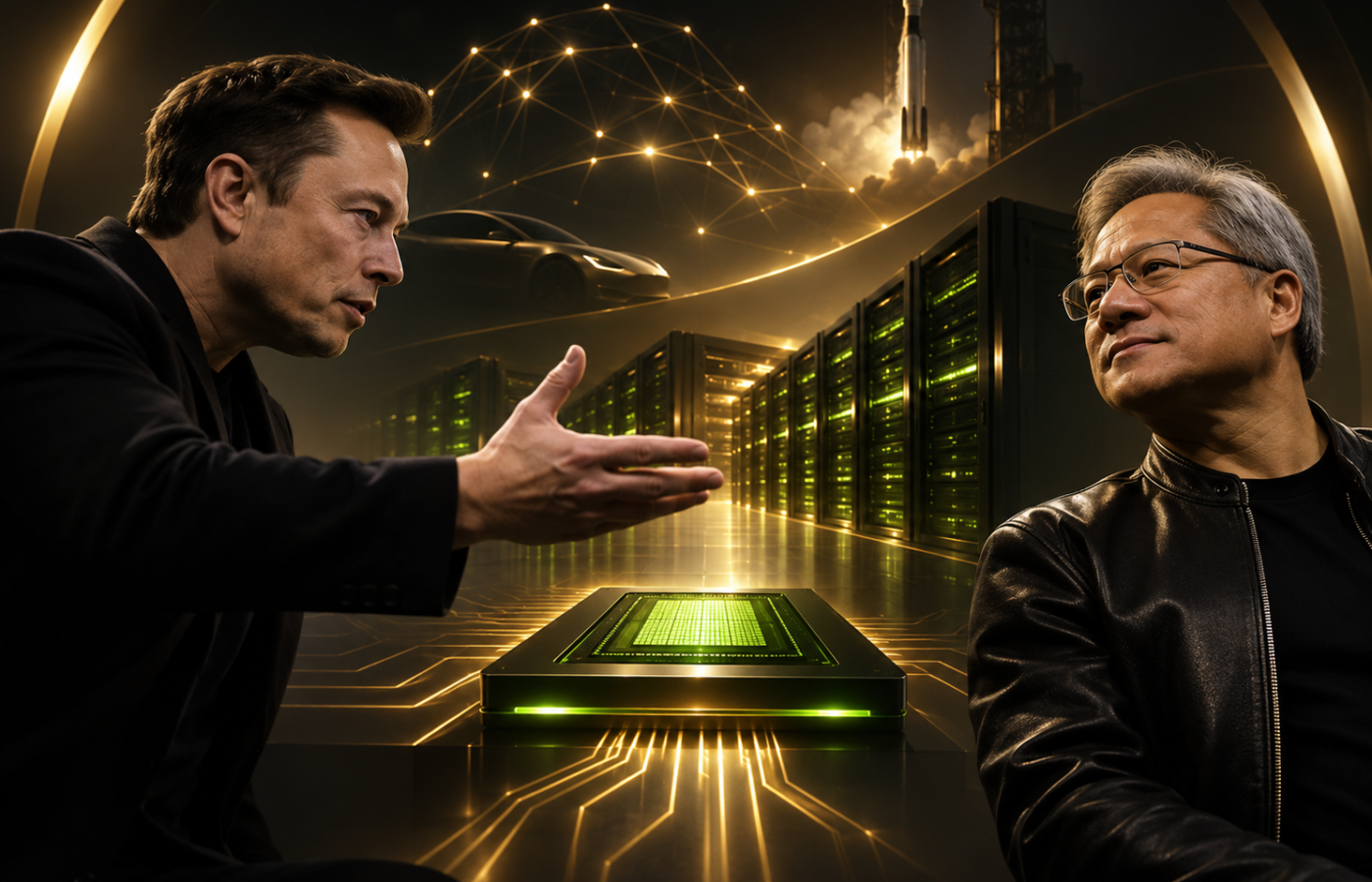
Elon Musk and NVIDIA have found themselves at the center of an unexpected confrontation. Musk has publicly supported Jensen Huang’s return as NVIDIA CEO, backed a petition calling for his reinstatement, and warned about the potential consequences of his departure. But this support goes beyond the personal relationship between two entrepreneurs. Tesla, SpaceX, xAI, and Musk’s entire AI empire depend heavily on NVIDIA’s technology and business decisions.
That raises an obvious question: Is Musk trying to protect Huang or his own multibillion-dollar projects?
Can Musk Bring Huang Back?
Musk has already made several significant moves. He supported the petition, warned that NVIDIA could lose important business agreements, publicly discussed his personal relationship with Huang, and even entertained the idea of hiring him.
All of this comes as Musk aggressively expands his own companies, which require increasingly massive computing resources.
However, Musk does not sit on NVIDIA’s board of directors and cannot reinstate Huang himself. His main tools are public influence, investor support, and the enormous purchasing power of his companies within the AI industry.
Is Musk fighting to restore NVIDIA’s longtime leader, or is he trying to preserve his direct access to one of the most important suppliers in his technology empire?
For now, those two objectives may be closely aligned.
How Dependent Are Musk’s Companies on NVIDIA?
Tesla: Cars, Robots, and Artificial Intelligence
Tesla is no longer just an electric vehicle manufacturer.
Autonomous driving, Robotaxi, and Optimus humanoid robots require enormous computing power. Tesla trains its neural networks using powerful computing clusters, including systems built around NVIDIA accelerators.
Tesla is also developing its own AI hardware, including specialized chips. However, building proprietary technology does not mean the company can completely eliminate its dependence on external suppliers.
Every new generation of autonomous driving software requires extensive model training and testing. As these projects grow, so does the demand for computing resources.
For Musk, the price and performance of the hardware are not the only concerns. Delivery schedules for next-generation accelerators are equally important.
Personal agreements with Huang may have helped Tesla secure equipment faster than conventional corporate procurement procedures would allow. The exact scale of those advantages remains unclear, but Musk himself has acknowledged dealing directly with Huang on multiple occasions.
xAI: Hundreds of Thousands of NVIDIA Accelerators
For Musk’s artificial intelligence business, securing hardware is even more critical.
Colossus, the supercomputer built to develop Grok, relies on NVIDIA technology. By February 2025, its infrastructure had expanded to 200,000 H100 accelerators.
And Musk’s ambitions go considerably further.
Developing Grok, training new models, and serving users all require increasingly powerful infrastructure. Scaling these systems depends on access to accelerators, memory, networking equipment, and electricity.
Meanwhile, xAI competes for computing resources with Google, Microsoft, Meta, OpenAI, and other major players in the AI industry.
The advantage does not necessarily belong to whoever is willing to pay the highest price. It also belongs to whoever can secure equipment and bring it online faster.
That makes Musk’s direct relationship with Huang potentially valuable from a commercial perspective.
Losing that relationship would not automatically stop NVIDIA shipments. But having direct access to the person making the company’s most important decisions is clearly different from a conventional supplier-customer relationship.
SpaceX: NVIDIA Goes Into Orbit
In February 2026, SpaceX acquired xAI, bringing Musk’s space and artificial intelligence businesses together under one corporate structure.
That gave the relationship with NVIDIA an entirely new dimension.
In August, NVIDIA announced plans for SpaceXAI to use Vera CPUs and the Vera Rubin platform to further expand Grok’s computing infrastructure.
But another project is even more ambitious.
SpaceXAI also announced the development of its first generation of Starmind satellites, designed to bring AI computing infrastructure directly into space.
The project is expected to use an optimized version of NVIDIA’s Vera Rubin NVL72 platform.
NVIDIA hardware is therefore being considered not only for terrestrial data centers but also for future orbital computing infrastructure.
These are still plans, not an operational network of space-based AI servers. However, developing Starmind would require long-term cooperation involving hardware, power consumption, cooling, and specialized computing systems.
For Musk, maintaining stable relationships with technology partners is particularly important at this scale.
X and Grok: Another Part of the Same System
The social media platform X is also closely connected to Musk’s artificial intelligence business.
Grok is integrated into the platform, while AI capabilities are increasingly used for information processing, search, and user-facing services.
X and the AI infrastructure now operate within the broader SpaceX corporate structure.
Several seemingly different businesses are therefore connected through a growing computing ecosystem.
Tesla is developing autonomous driving and robotics. SpaceX is building space infrastructure. Grok requires massive computing resources for training and serving AI models, while X provides access to a large digital platform.
For all these projects, access to advanced AI hardware matters, although the level of dependence varies.
Why Does Musk Want Huang Specifically?
Musk’s main argument is not that NVIDIA cannot operate without its founder.
It is about personal trust and commitments that were actually delivered.
In a technology industry where access to manufacturing capacity can be allocated years in advance, that kind of trust can have enormous commercial value.
Musk knows whom to call, whom to negotiate with, and whose promises he can rely on. According to Musk, Huang consistently delivered on those promises.
A new NVIDIA CEO might preserve existing business relationships, but nobody can guarantee the same speed of decision-making.
Musk Moves From Words to Action
On November 13, Elon Musk announced his support for a petition demanding Jensen Huang’s reinstatement. By November 15, the petition had collected more than 135,000 signatures, including those of technology executives, investors, and thousands of people identifying themselves as NVIDIA employees.
Musk did not stop at signing the petition. He publicly questioned NVIDIA’s leadership decision and explained why he believes Huang’s return matters.
According to Musk, Jensen personally secured major agreements with suppliers, many of which were based on trust rather than signed contracts.
Musk also described his own experience. When Huang promised computing capacity or accelerated hardware deliveries, those promises were fulfilled. Formal paperwork could follow later.
This goes beyond publicly supporting a former CEO. Musk is effectively acknowledging that he personally benefited from this relationship and does not want to lose those advantages.
He also responded to a suggestion that he hire Huang by saying it would be an honor.
No specific position or formal job offer has been announced.
Sources
- Reuters: Musk Says NVIDIA Will Lose Critical Deals Without Jensen Huang
- TechCrunch: Elon Musk and Other Tech Executives Back Petition to Reinstate Jensen Huang
- xAI: Colossus Supercomputer
- NVIDIA: SpaceXAI Adopts NVIDIA Vera CPUs