
The Market Bought Bitcoin. The Fed Took It Back

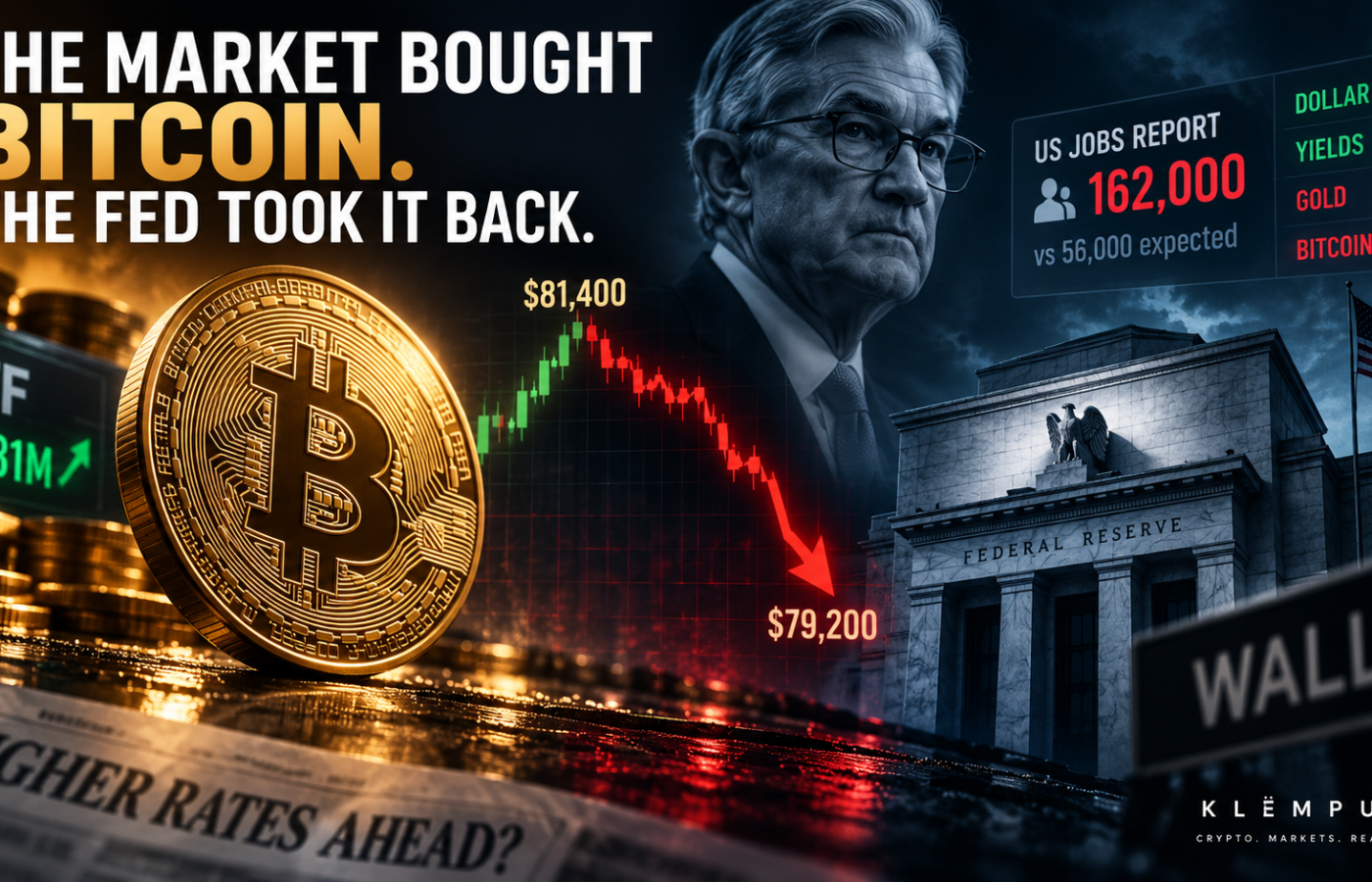
Bitcoin was heading toward $82,000 in the morning, U.S. ETFs had just attracted hundreds of millions of dollars in fresh capital, and the market was increasingly pricing in a Fed pause. Then the U.S. published one number — 162,000 new jobs. Within minutes, BTC lost the $80,000 level, gold moved lower, while the dollar and Treasury yields climbed. Nothing broke inside crypto. Only the expected price of money changed.
September 4 started with an almost ideal combination of factors for Bitcoin. The day before, comments from Federal Reserve Governor Christopher Waller had pushed the market to reduce expectations for another rate hike in September. Bitcoin climbed from roughly $77,000 to nearly $81,400 — its highest level since mid-May — while U.S. spot Bitcoin ETFs attracted around $731 million in net inflows in a single day.
Demand for Bitcoin was real. Capital was clearly entering the market. A few hours later, however, it became obvious that this was not enough.
At 3:30 PM Riga time, the U.S. labor market report was released. Instead of the roughly 56,000 new jobs expected by the market, the U.S. economy added 162,000 — almost three times the forecast. Unemployment remained at 4.1%, while July’s result, initially estimated as a loss of 23,000 jobs, was revised to a gain of 21,000.
Within minutes, the market was looking at a very different U.S. economy.
In the morning, the market expected a softer Fed. By evening, it no longer did
For months, investors had been watching closely for signs that the U.S. labor market was cooling. The logic was simple: the weaker the economy becomes, the less room the Federal Reserve has to keep rates high or raise them again.
That was the logic behind Bitcoin’s morning rally.
If the labor market slows, the probability of another rate hike falls. That means the cost of money stops rising, pressure on bonds eases, the dollar loses part of its support, and capital becomes more willing to move back into risk assets.
The August jobs report broke that setup.
The U.S. did not show a weak labor market. It showed one that was unexpectedly strong. For the Fed, that means the economy may still be able to absorb high rates, leaving room for further tightening if inflation remains a problem. After the report, the probability of a September rate hike moved back toward roughly 60–65%.
At that point, the market stopped trading the Bitcoin recovery story and started trading the price of the dollar again.
Why good economic news became bad news for Bitcoin
At first glance, a strong labor market should be positive. People are employed, companies are hiring, and consumer demand remains resilient.
Financial markets, however, see the picture differently.
When the economy remains strong, the Federal Reserve can keep interest rates elevated for longer. High rates make U.S. government bonds more attractive, increase borrowing costs, and raise the return investors can earn on relatively low-risk instruments.
At that point, Bitcoin is no longer competing only with Ethereum, Solana, or gold. It is competing with U.S. Treasuries, money-market instruments, and dollar yields.
That is why one employment number can overwhelm even a strong inflow into Bitcoin ETFs.
Before the data was released, Bitcoin was trading above $81,000. After the jobs report, the price quickly fell below $80,000.
Nothing had changed inside the crypto industry itself. There was no major protocol exploit, no exchange failure, no new ban, and no problem with the Bitcoin network. On the contrary, U.S. ETFs had just taken in hundreds of millions of dollars in fresh capital.
Only the market’s estimate of future money costs had changed.
And that was enough.
Institutional Bitcoin now lives by institutional rules
For years, the crypto market waited for Wall Street to arrive. Spot ETFs were supposed to bring institutional capital. Banks were supposed to open access to larger clients. Asset managers were supposed to turn Bitcoin into a fully recognized asset class.
That happened.
But institutional money also brought institutional dependencies.
A professional investor does not look at BTC in isolation. The same portfolio also tracks Treasury yields, the dollar, inflation, the Fed’s policy rate, equity indices, gold, and hedging costs.
If the return on low-risk assets rises, risk assets need to offer more. If they do not, some capital starts moving toward more predictable instruments.
That is why $731 million of inflows into Bitcoin ETFs may look enormous inside the crypto market, yet remain only one variable in the broader global financial system.
Gold took the same hit
That is also why Bitcoin’s decline cannot be explained by some hidden crypto-specific problem.
Gold fell after the labor report as well. The dollar strengthened, U.S. Treasury yields rose, and the relative appeal of assets that do not produce interest income weakened.
This matters.
Bitcoin and gold found themselves on the same side of the trade. Neither asset did anything wrong. The opportunity cost of holding them simply increased.
The higher government bond yields go, the more an investor has to believe in the future upside of Bitcoin or gold to justify giving up near-guaranteed dollar returns.
That makes today’s reaction more important than another debate over whether Bitcoin is “digital gold.”
Both assets were hit by the same force: expensive money.
The market is calculating interest again
There is another important detail. U.S. government bond yields remain high, while demand for capital is increasing not only from the government but also from the technology sector.
AI infrastructure, data centers, energy projects, and large corporate investments are creating enormous financing needs. Money is becoming a scarce resource again, and the cost of capital is no longer a minor detail.
For Bitcoin, this is a fundamentally different environment from the era of near-zero interest rates.
In the past, an investor could hold cash and earn almost nothing. Today, noticeable dollar returns are available without taking on crypto-market volatility.
In that environment, the story of Bitcoin’s fixed supply is no longer enough on its own. The asset has to keep proving that its potential return justifies its risk.
One jobs report has not decided everything
At the same time, today’s NFP does not mean the Fed will definitely raise rates.
Average hourly earnings rose by around 3.1% year over year, which does not yet look like a fresh surge in wage inflation. The labor market was strong, but not necessarily overheated.
Before the Fed meeting, investors will receive more inflation and economic data. If CPI comes in weaker than expected, the market could quickly return to the pause scenario. If inflation remains elevated, the combination of strong employment and persistent price pressure will give the Fed much more room to tighten again.
So today’s report did not determine Bitcoin’s fate.
It simply showed how quickly the market can rewrite its own scenario.
What actually happened
On the surface, the story is simple: Bitcoin traded above $81,000 in the morning and fell back below $80,000 later in the day.
But far more happened underneath that move.
Investors first received a softer signal from the Fed. Then hundreds of millions of dollars flowed into Bitcoin ETFs. The price climbed toward a multi-month high.
After that, a single macroeconomic report was able to overwhelm nearly all of that optimism within minutes.
That is more important than the candle on the chart.
Bitcoin can no longer be analyzed properly by looking only at the blockchain. You can study hashrate, ETF flows, whale movements, liquidations, exchange reserves, and miner activity — and still miss the biggest risk.
Because sometimes the biggest risk to Bitcoin arrives in an ordinary report from the U.S. Department of Labor.
KLJO Conclusion
For years, we waited for the moment when big money would finally recognize Bitcoin as a real financial asset.
It looks like that moment has arrived.
But recognition came with a condition that was discussed much less often.
A real financial asset has to live by the rules of the real financial market.
Today, hundreds of millions of dollars flowed into Bitcoin. One number from Washington was still enough to overpower them.
When money becomes expensive, even Bitcoin starts counting interest.
Sources
U.S. Bureau of Labor Statistics — Employment Situation, August 2026
Reuters — US nonfarm payrolls blow past expectations in August
Reuters — Gold slides after robust US payrolls
CoinDesk — Bitcoin below $80,000 after US jobs report